The Grand Canal, Venice, Looking South toward the Rialto Bridge by Canaletto
This is Canaletto's 'The Grand Canal, Venice, Looking South toward the Rialto Bridge,' painted in 1734 and now at The Metropolitan Museum of Art. At first glance it is a postcard-perfect vista of 18th-century Venice, but the painting functions as something more precise: a coded map of commercial power.
Look at the two anchoring structures. On the left, the Rialto Bridge with its crowded market arcades at the base. On the right, the long colonnade of the Fondaco dei Tedeschi, the German merchants' exchange. These were the two most important trading hubs in the Republic. Canaletto has placed them opposite each other across the water, framing the busiest stretch of the Grand Canal.
Canaletto painted this during the height of the Grand Tour, when wealthy British travelers collected his vedute as souvenirs. He likely used a camera obscura to achieve the lens-like recession of the distant rooflines. The gondolas and barges in the foreground, including the black private cabin called a felze, document the social layers using the waterway, from hidden elites to standing gondoliers.
Every balcony, arcade, and vessel is a working piece of the Venetian economy. What other details do you notice in the margins of the city?
Details
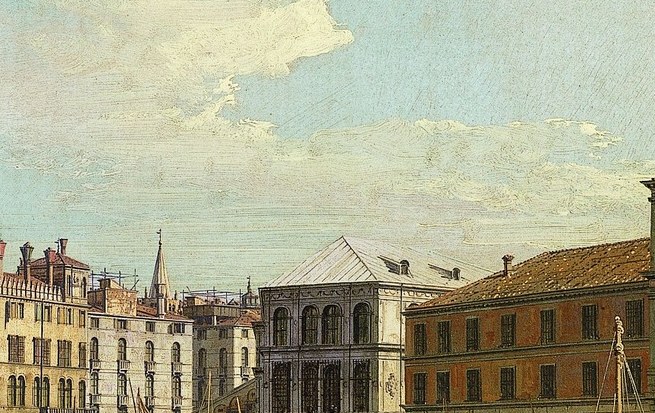
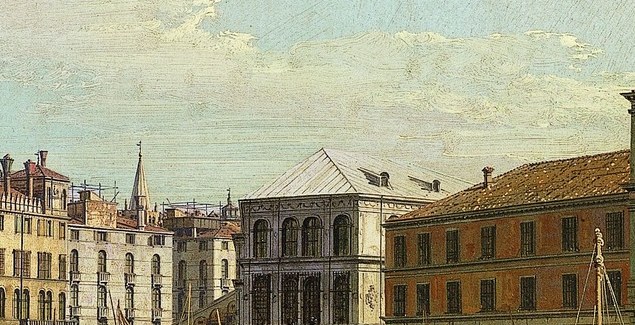
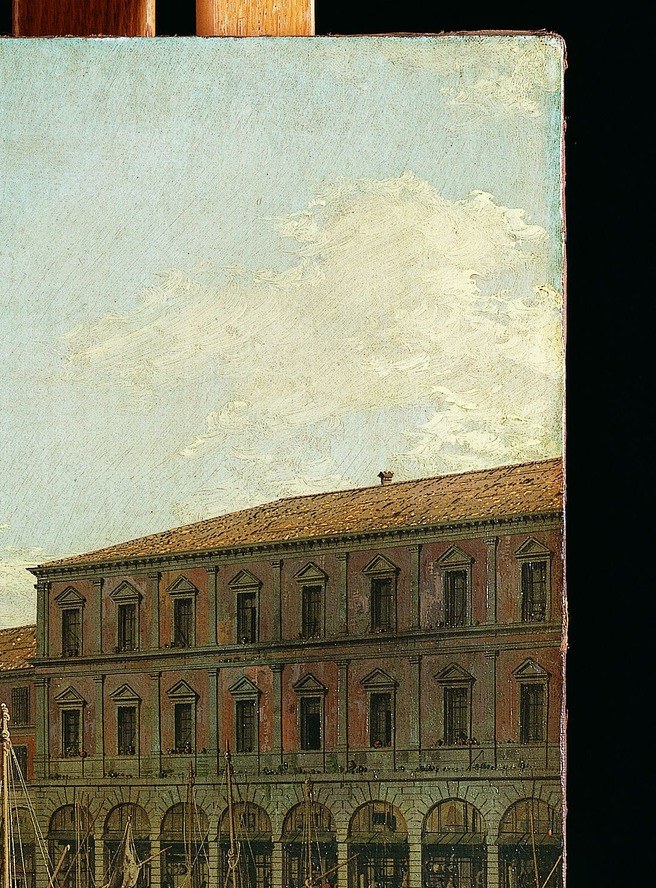
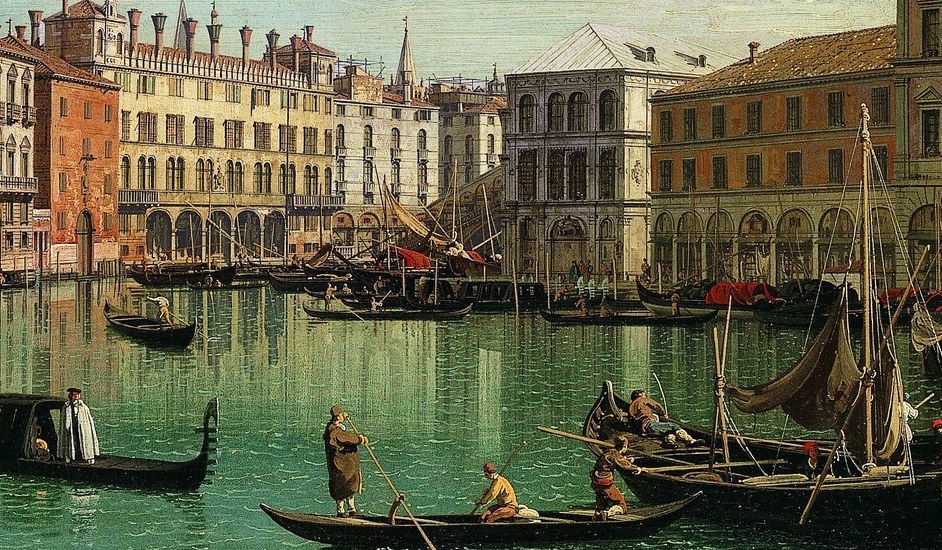
Transcript
This is not just a view of Venice. It is a map of who ran the city. Start here: the Rialto Bridge. The financial heart of the Republic. Those arcades at its base housed Europe's most famous commodity exchange. Now the right bank. The long colonnade at water level. That was the Fondaco dei Tedeschi, the German merchants' exchange. Every power broker in Venice passed through one of these two buildings.