Portrait of a Lady by Daniel F. Ames
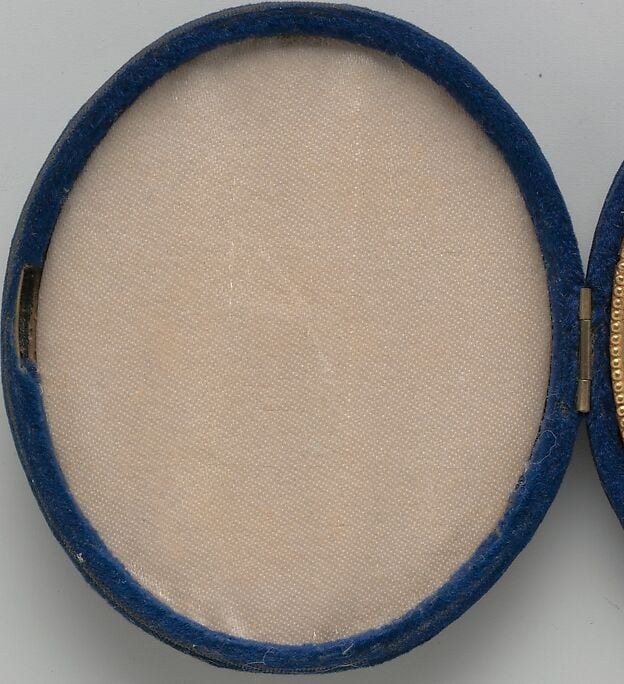
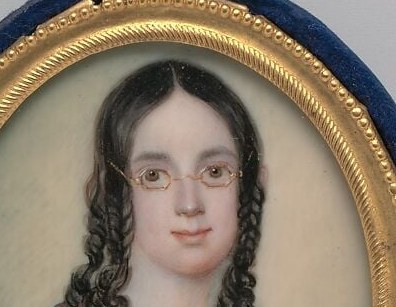
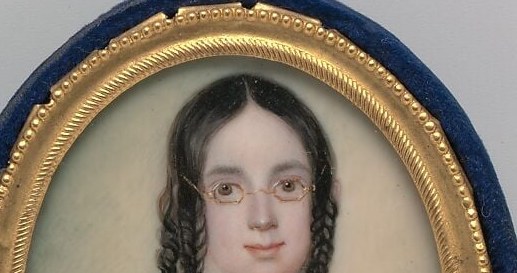
This is "Portrait of a Lady," a watercolor on ivory miniature by American artist Daniel F. Ames, painted around 1845. It is not a framed picture but a locket, designed to be worn or carried against the body. The gilded case opens to reveal two compartments; one holds the portrait, the other is empty. It was made to hold a pair, most likely the sitter and her husband, and the missing half turns this object into a quiet record of loss.
Look at her face. The directness of her gaze is unusual for a female sitter in the 1840s, but what stops you are the round wire spectacles. Eyewear appears on men in miniatures of this period; it is almost never granted to women, who were typically painted as decorative ideals. Ames chose to record her exactly as she presented herself: clear-eyed, intelligent, and serious.
The miniature technique itself does much of the work. Ames built the skin tones with transparent washes over luminous bare ivory, leaving the corners unpainted. The ivory glows through the paint, which is why her face reads as warm and alive even at this tiny scale. The dark dress and white collar anchor the composition and date the fashion securely to the mid-1840s.
Who was she? The lost companion locket and the small jet brooch pinned at her bodice suggest she was a wife and very likely a widow by the time she sat for this. She is not performing grief. She is simply present. A woman who wore spectacles, looked the artist in the eye, and refused to vanish into an ideal.
Details


Transcript
This portrait was made to be held, not hung. It is a locket, and one side is empty. Someone was meant to face her from the other half. The other portrait is lost. She alone remains. Look at what she is wearing. Round spectacles. Almost never seen on women in 1840s portraiture. She was educated. A reader. Uninterested in performing prettiness.