明/清 李在 董巨馬夏合風山水圖 卷|Landscape after Dong Yuan, Juran, Ma Yuan, and Xia Gui by Li Zai
Li Zai's handscroll "Landscape after Dong Yuan, Juran, Ma Yuan, and Xia Gui" (1655) is a 17th-century masterclass disguised as a mountain. Painted in ink and color on paper, the work is not a simple vista. It is a deliberate synthesis of four distinct brush idioms from the Song and Yuan dynasties, all fused into a single coherent landscape.
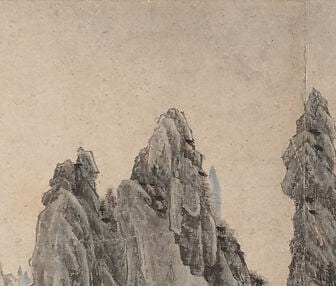
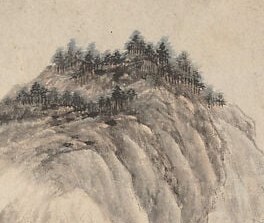
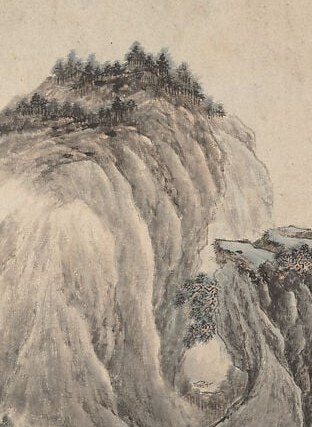
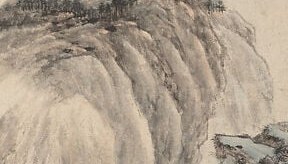
Scan the composition. The sharp, angular central spire rising like a needle records the hand of Ma Yuan and his "one-corner" sensibility. Immediately beside it, the dense, layered texture on the left cliff face deploys Dong Yuan's legendary "hemp-fiber" strokes. In the shifting mist and wet ink washes of the distant peaks, the influences of Juran and Xia Gui complete the conversation.
Active in the 17th century, Li Zai was participating in a long Chinese tradition of artists learning by direct dialogue with the dead. This was not copying. It was a physical, intellectual engagement where painting became a form of historical study and personal homage, proving mastery through the ability to channel multiple ancestors at once.
Next time you see a mountain, ask not just who painted it, but which four painters they were quoting.
Details

Transcript
This is not one painting. It is four. Look at the sharp central spire. That angular stroke is Ma Yuan's signature. Now the left cliff. Dense, textured, ancient. This is Dong Yuan's hemp-fiber texture line. In 1655, Li Zai built a single mountain. From the bones of four Song dynasty masters.