The Last of the Buffalo by Bierstadt, Albert
View the artwork: The Last of the Buffalo →
Albert Bierstadt completed The Last of the Buffalo around 1888, and the painting’s title double-encodes a terrible statistic: by the time he set brush to this six-by-ten-foot canvas, the American bison population had collapsed from roughly thirty million to about one thousand. The work hangs today in the National Gallery of Art in Washington, D.C., and it is as much a constructed lament as it is a Western landscape.
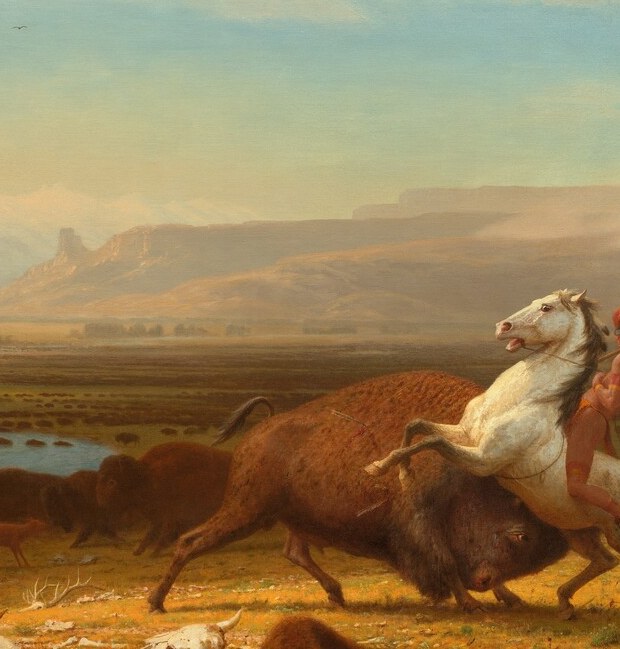
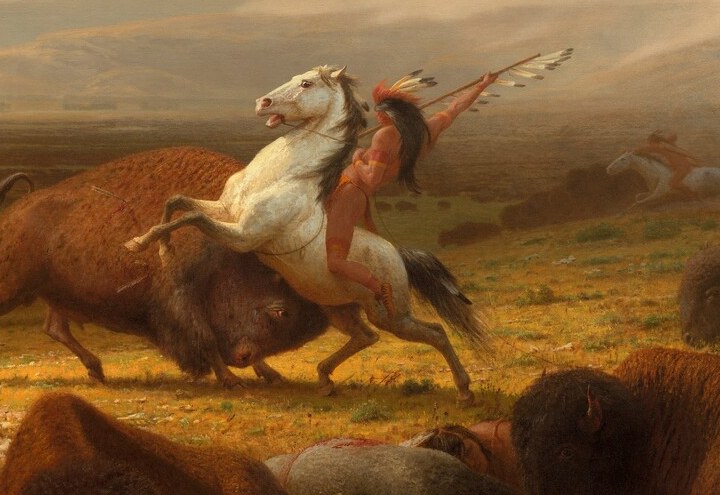
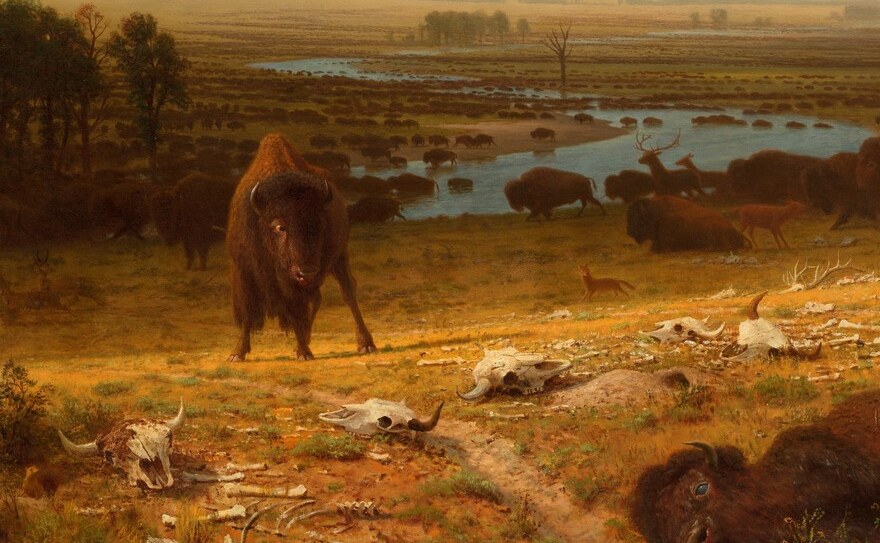
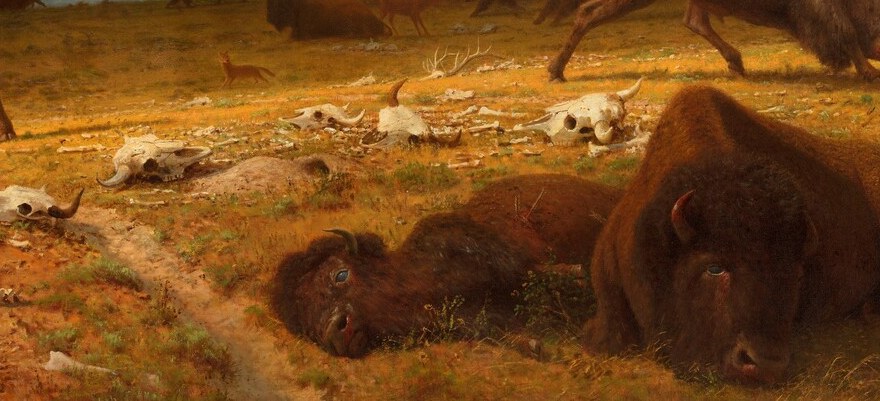
Bierstadt built the picture as a series of visual brackets. Two dark fallen buffalo anchor the left and right foreground, and between them the central trio of hunter, horse, and charging bull plays out. But the detail that changes the meaning sits below all of that: a scatter of bleached skulls and sun-whitened bones right along the picture plane. They are not part of the hunt you’re watching, they are what came before, and what is coming.
The artist never saw this exact scene. He assembled it from sketches gathered across 1859, 1863, 1871, and a final trip to Yellowstone in 1881. The Paris Exposition committee rejected the painting as old-fashioned, so Bierstadt showed it at the Paris Salon instead, where Lakota performers traveling with Buffalo Bill’s Wild West show reportedly visited it.
When you stand in front of the canvas, your eye goes straight to the white horse and the locked horns. But the painting’s real argument is quieter, and lower down, a reminder that a species doesn’t vanish in one fight. It vanishes in the spaces between them.
#arthistory #AlbertBierstadt #HudsonRiverSchool
Details
Transcript
Look first at the dead buffalo on the left. Now look right. Another fallen animal frames the scene. Between them, the central fight: hunter, horse, charging bull. By the 1880s, the American bison had gone from 30 million to roughly 1,000. Now let your eye drop to the very bottom of the canvas. These aren't fresh kills. They're bleached skulls, decades of slaughter. Bierstadt painted a carpet of bones framing the living. The hunter's lance drives downward into the animal body.