Artwork
The Last of the Buffalo
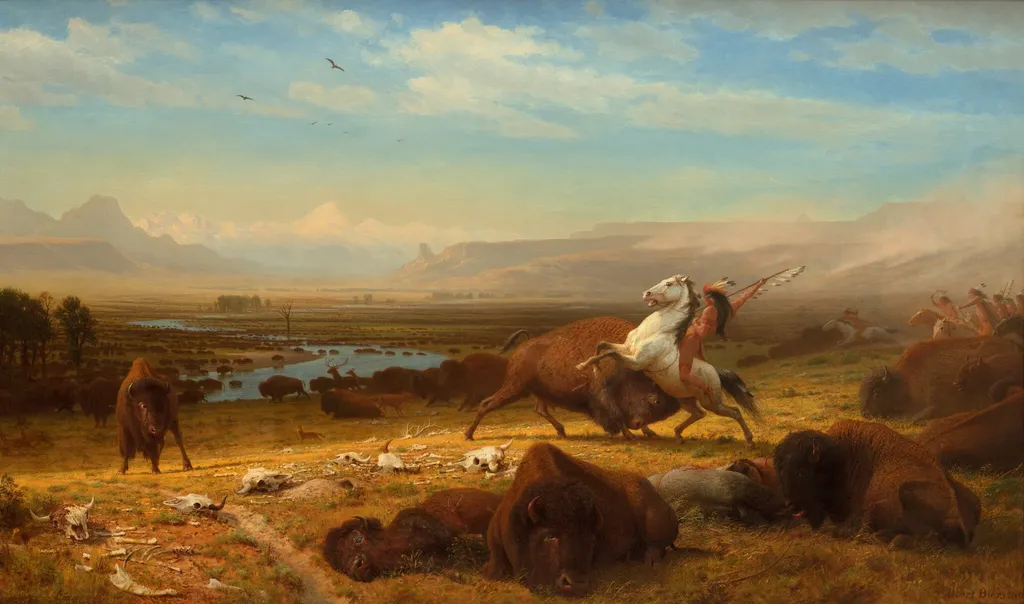
The Last of the Buffalo is an oil painting by the American Impressionist artist Albert Bierstadt. It dates from 1888 and is held in the collection of the National Gallery of Art.
- Inscription
- Inscribed:lower right: Albert Bierstadt
About this work
The Corcoran Gallery bought it in 1909 from the artist's widow, and it joined the National Gallery of Art in 2014 with the Corcoran Collection.
A Plains Indian on horseback fights a charging buffalo at the center of Albert Bierstadt's six-by-ten-foot canvas, with skulls and bones scattered across the foreground. Painted in 1888 from his western expedition sketches and 1881 Yellowstone studies, it came as the bison population had crashed from roughly thirty million to about a thousand. The Corcoran Gallery bought it in 1909 from the artist's widow, and it joined the National Gallery of Art in 2014 with the Corcoran Collection.
Subject & Meaning
The painting depicts a dramatic buffalo hunt by Native Americans on horseback set against a vast plain with snow-capped peaks. The foreground includes dead and injured buffalo, while herds cross a river and graze in the distance, surrounded by diverse wildlife such as deer, coyote, pronghorn, fox, rabbit, and a prairie dog. Conceived as a melancholy reflection on westward expansion, the work laments the near-extinction of buffalo due to overhunting.
Bierstadt offers an idealized, romanticized version of a vanishing America, and some interpretations criticize the composition for implying Native Americans were primarily responsible for the slaughter, whereas white settlers were the main cause. As his last large canvas, the painting also signals the decline of the Hudson River School's sublime aesthetic.
Technique & Style
The Last of the Buffalo is an oil-on-canvas painting measuring 180.3 × 301 cm, signed by Bierstadt at lower right and executed in 1888. It is the artist's last large-scale canvas, combining elements he had sketched during his western expeditions. The composition features a detailed foreground with dead or wounded buffalo and a profusion of wildlife, including deer, coyotes, antelope, foxes, a rabbit, and a prairie dog, while in the background a herd crosses a river and other animals graze beneath snow-covered peaks.
Despite the minute depiction of fauna and landscape, the central confrontation and herd are presented as a romanticized idealization rather than a realistic portrayal of plains life. The work belongs to the Hudson River School, specifically the Rocky Mountain School branch.
History & Provenance
The Last of the Buffalo was painted by Albert Bierstadt in 1888, his final large-scale canvas, synthesizing sketches from his western expeditions. The painting remained in the artist's collection in New York City before passing to his brother Edward Bierstadt by 1908. It was sold at auction by the American Art Association in 1908 to D.G. Reid of New York.
By February 1909, it had been acquired by Mary Stewart Bierstadt, the artist's wife. On April 19, 1909, the Corcoran Gallery of Art in Washington purchased the painting, where it remained until 2014, when it was acquired by the National Gallery of Art.
The Last of the Buffalo is held at the National Gallery of Art in Washington, D.C., where it was accessioned in 2014 following its transfer from the Corcoran Gallery of Art. The Corcoran acquired the painting on 19 April 1909, after it had passed through the hands of Edward Bierstadt, D.G. Reid, and Mary Stewart Bierstadt.
Context
Albert Bierstadt's The Last of the Buffalo (1888) is frequently interpreted as a melancholic meditation on westward expansion, the near-extinction of bison herds, and the forced displacement of Native Americans onto reservations. The work was the artist's last large canvas and a culmination of sketches from his western expeditions. However, by the time of the 1889 Paris Exposition, changing artistic tastes favored Realism and the Barbizon school, and the painting was excluded from the exhibition, a rejection that marked the decline of Bierstadt's career.
Critics and scholars note that the painting offers an idealized, romanticized vision of the vanishing American frontier, ultimately representing the end of both the buffalo and the American sublime aesthetic that Bierstadt and the Hudson River School had championed. The work nonetheless retains a historical place as a symbol of 19th-century American landscape painting and was later commemorated on a 1998 U.S. postage stamp.
Legacy
The Last of the Buffalo is Albert Bierstadt's final large canvas, and its legacy includes recognition as a commemorative image. In 1998, the United States Postal Service issued a set of stamps titled "Four Centuries of American Art," which featured this painting. The work's later reputation is tied to its role as an emblem of the vanishing American West, a theme that continues to resonate in art-historical discourse.
Overview
Albert Bierstadt completed The Last of the Buffalo, a monumental oil on canvas measuring six by ten feet, in 1888. This painting is recognized as a significant late work in his Western series. It depicts a dramatic confrontation between a Native American hunter on horseback and a charging buffalo within a vast Great Plains landscape.
The scene, a composite drawn from Bierstadt's extensive travels, subtly addresses the profound environmental changes occurring in the American West during his lifetime.
Own this work as a print
Artist & collection

Artist
Albert Bierstadt (January 7, 1830 – February 18, 1902) was a German-American painter best known for his lavish, sweeping landscapes of the American West.