The Falls of Niagara by Edward Hicks
View the artwork: The Falls of Niagara →
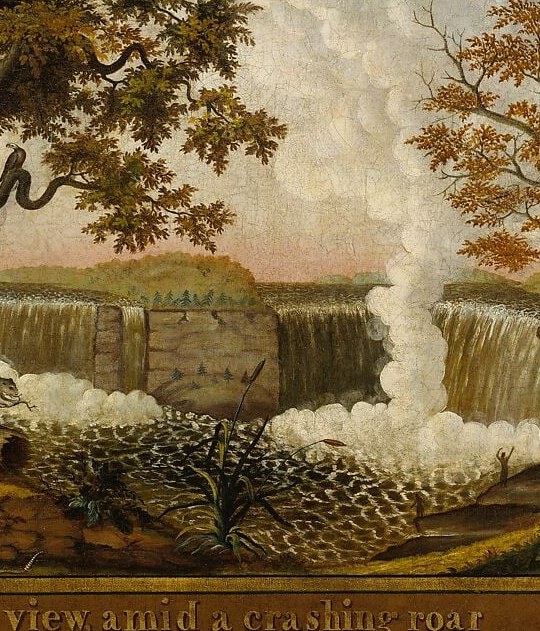
The Falls of Niagara, painted around 1825 by the Quaker preacher and artist Edward Hicks, looks like a straightforward landscape. It is anything but. This is a moral parable, hiding its true meaning in plain sight.
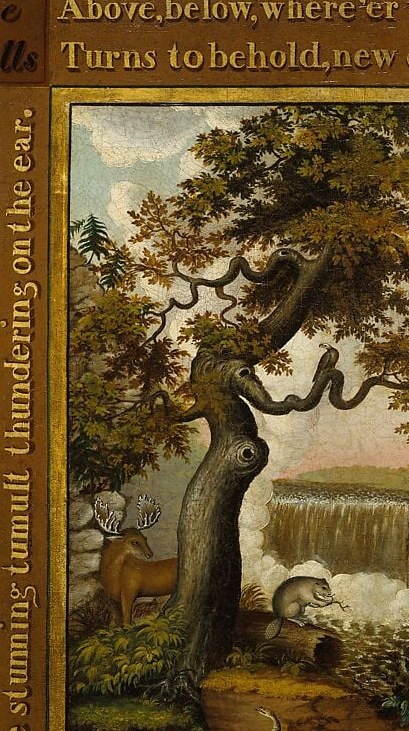
Hicks never stood at the falls to paint this. He based the entire composition on an engraved map view from 1822. The scene itself, seen from the Canadian side, is a stage. Scan the foreground carefully and you will find four animals: a moose, a beaver, an eagle, and a coiled rattlesnake. These were not random choices. They were a recognized emblem set of American identity, and for Hicks, the snake represented the dangerous beauty of his young nation, while the eagle soared as its better angel.
The painting is framed by an encircling poem, extracts from Alexander Wilson's 'The Foresters,' inscribed on all four borders. The bottom text reads: 'This is for ever-living Time's great God adore.' Everything in this work, the animals, the text, the copied view, was built to turn a natural wonder into a devotional warning.
Hicks painted over 60 versions of his famous Peaceable Kingdom scenes, and The Falls of Niagara is a companion piece to that sermon. It is currently in the collection of the Metropolitan Museum of Art. How many of the four creatures can you find?
#arthistory #americanart #hiddenfigures
Details



Transcript
At first glance, a postcard view of Niagara. But the painter never actually stood in front of it. He copied it from an 1822 map. Edward Hicks was a Quaker preacher. Every detail had a purpose. Look for the beaver. Emblem of wild abundance. Now find the eagle. The nation's symbol, soaring. And here, coiled just off the path. The rattlesnake is America's own dangerous beauty. Peril beneath the sublime.