Artwork
The Falls of Niagara
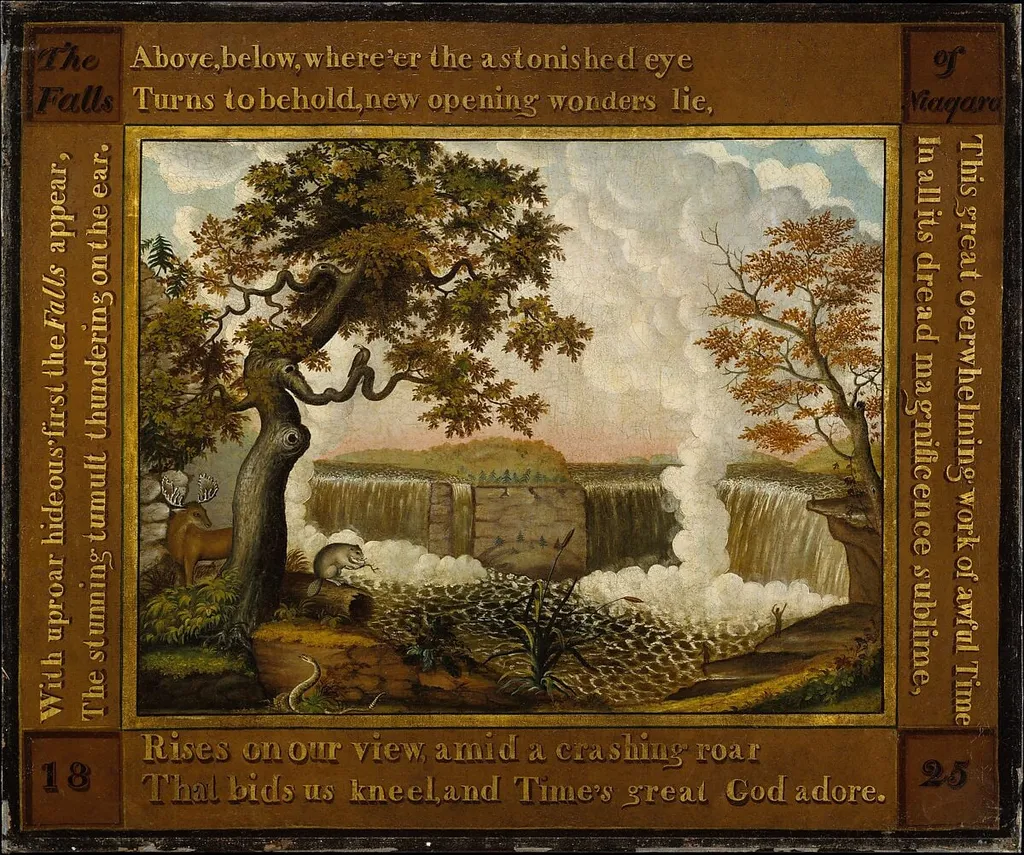
The Falls of Niagara is an oil painting by the American Folk Art artist Edward Hicks. It dates from 1825 and is held in the collection of the Metropolitan Museum of Art.
- Accession no.
- 62.256.3
- Credit line
- Gift of Edgar William and Bernice Chrysler Garbisch, 1962
About this work
Subject & Meaning
In the foreground Hicks places characteristic North American fauna, a moose, a beaver, a rattlesnake and an eagle, alongside trees that frame the falls.
The painting presents a sweeping view of Niagara Falls from the Canadian shore, centered on the cascading water and surrounding woodland. In the foreground Hicks places characteristic North American fauna, a moose, a beaver, a rattlesnake and an eagle, alongside trees that frame the falls. A broad painted border encircles the scene and carries hand‑lettered verses from Alexander Wilson’s poem The Foresters.
Together the natural spectacle and the emblematic animals convey a celebration of the continent’s wilderness and its symbolic virtues of strength, industry and liberty, while the poetic inscription links the landscape to a nascent American cultural identity.
Technique & Style
The Falls of Niagara is an oil painting on canvas dated to circa 1825. Executed in oil paint, the work presents a landscape view of Niagara Falls taken from the Canadian side, incorporating detailed depictions of an eagle, snake, tree, waterfall, moose, beaver, and rattlesnake. The composition follows an earlier depiction by Henry Schenck Tanner from an 1822 map of North America.
A wide border surrounds the image and is inscribed with extracts from Alexander Wilson’s poem “The Foresters,” running clockwise from the left.
History & Provenance
Edward Hicks painted The Falls of Niagara in 1825, an oil on canvas work now in the Metropolitan Museum of Art. The painting was created after Hicks visited Niagara Falls in 1819 and drew on an earlier depiction of the falls by Henry Schenck Tanner from an 1822 map. Hicks composed the scene from the Canadian side, populating the border with symbolic animals such as eagle, snake, beaver and moose, and inscribed extracts from Alexander Wilson’s poem The Foresters around the edge.
The work belongs to the American Wing’s landscape genre and remains part of the museum’s permanent collection. No documentation of a specific commission has been identified in the cited references.
Edward Hicks's The Falls of Niagara (c. 1825) is held in the collection of the Metropolitan Museum of Art, specifically within its American Wing. While the painting is documented as part of this institution's holdings, the available records do not provide a specific accession or inventory number for the work, nor any documented exhibition history.
Context
Edward Hicks completed The Falls of Niagara in 1825, an oil on canvas landscape that belongs to the American Wing of the Metropolitan Museum of Art. The work depicts a Canadian view of the falls surrounded by symbolic flora and fauna such as eagle, snake, tree, beaver and moose, and includes inscribed lines from Alexander Wilson’s poem The Foresters, linking it to contemporary literature. Hicks had visited the falls in 1819, but the image draws on Henry Schenck Tanner’s 1822 map, connecting the painting to early 19th‑century cartographic representations of North America.
As a rare secular subject in Hicks’s oeuvre, the work exemplifies the 1825 moment when American artists began to explore national landscapes, situating it within scholarly discussions of early American visual culture.
Overview
Edward Hicks completed The Falls of Niagara around 1825, rendering the dramatic natural landmark in oil on canvas. This work is held within the American Wing of the Metropolitan Museum of Art. While depicting a recognizable landscape, the painting incorporates various animal figures and textual elements, suggesting a deeper symbolic intent beyond mere topographical representation.
Artist & collection

Artist
Edward Hicks spent his life caught between two worlds. A Quaker preacher by Sunday and a painter by weekdays, he painted signs and carriages to support his family while quietly building a body of peaceful, crowded…