New Jersey Beach by William Trost Richards
William Trost Richards painted "New Jersey Beach" in 1901, an oil on canvas now tucked away from the more dramatic storms and sunsets of his era. He chose an overcast day, a quiet stretch of sand, and a tide coming in.
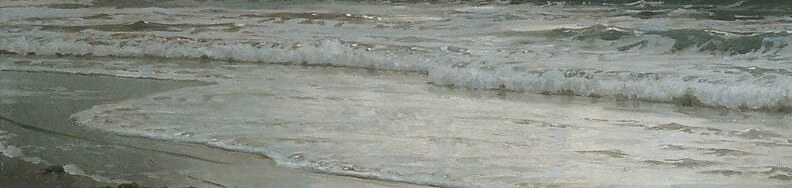
Look first at the wet sand. It mirrors the pale sky so faithfully that the composition feels stitched together vertically. Then find the thinning, lacy edge of the wave where the foam dissolves. Richards mapped that exact moment with controlled, irregular brushwork: a translucent water-body collapsing onto a solid.
Richards was a meticulous observer tied to the American Pre-Raphaelite movement earlier in his career. By 1901, that precision had softened into a quiet, luminous realism. Nature provided the structure; he refused to exaggerate it.
What you are really seeing is an argument in paint: that an ordinary day, a flat horizon, and a fading wave contain enough light to fill a canvas.
Details




Transcript
Half this painting is just sky. A gray, overcast day on the Jersey Shore. No drama. But look at the sand. It holds the entire sky like a mirror. Richards built this using tiny, shimmering brushstrokes. But the real magic is right here. This foam isn't white. It's sand, water, and air. In 1901, he painted the instant a wave stops being a wave.