Hunter and Hounds being Judged by Paulus Potter
Paulus Potter painted Hunter and Hounds being Judged around 1650, and then he died of tuberculosis at 28. This single canvas amounts to his doctoral thesis in animal anatomy, a panoramic court where every fur, hide, bristle, and fold of skin gets its own argument.
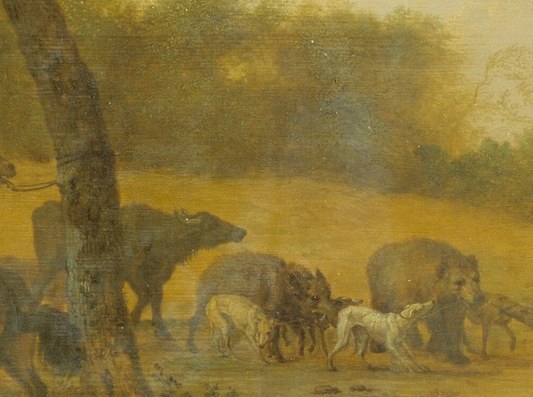
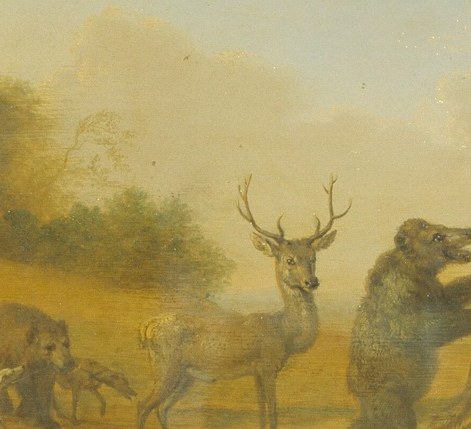
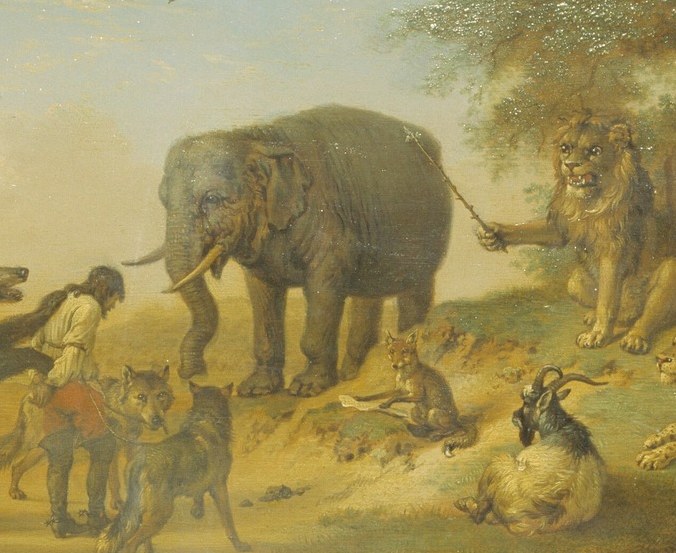
Look past the strange premise, an animal assembly judging a hunter, and see it as a sampler of technique. The massive bull on the left-center dominates with sheer weight; Potter gave its hide a density the stag beside it deliberately lacks. Move right to the elephants and watch the skin fold around the shoulder. Then drop your eye to the foreground earth, where smaller creatures, rabbits, birds, reward a close look the way a Dutch still life hides insects among the petals.
Potter produced roughly one hundred paintings in his short career, nearly all of them animal landscapes. His bull portraits were the most sought-after, but panoramas like this proved he could render anything warm-blooded. The elephants alone were a technical statement: live specimens were rare in Holland, and most painters copied prints. Potter studied them in person.
The painting lives now at the State Hermitage Museum. A kid who worked himself to death before thirty left them a complete encyclopedia of animal life. Next time you see one of his bulls, you will know who built it.
Details


Transcript
He died at 28. This is his technical résumé. The bull presides. Its hide is a lesson in weight. Now move to the stag. Antlers crown the sky. Potter studied real elephants. Feel the skin folding. And down at ground level: smaller lives in the trampled earth. One hundred paintings. Every animal a different technical problem, solved.