Untitled by Shen Zhou
This is an album leaf painted by Shen Zhou in 1468. It has no official title, just a boat, a mountain, and a river of unpainted paper. The work lives in a tradition of private contemplation, meant to be held in the hands rather than hung on a wall.
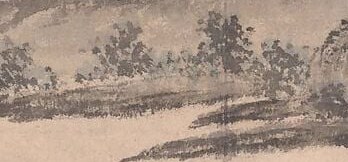
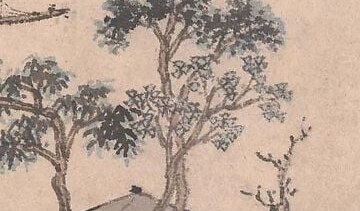
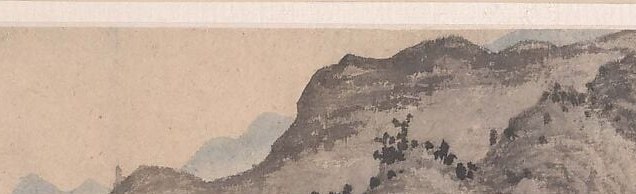
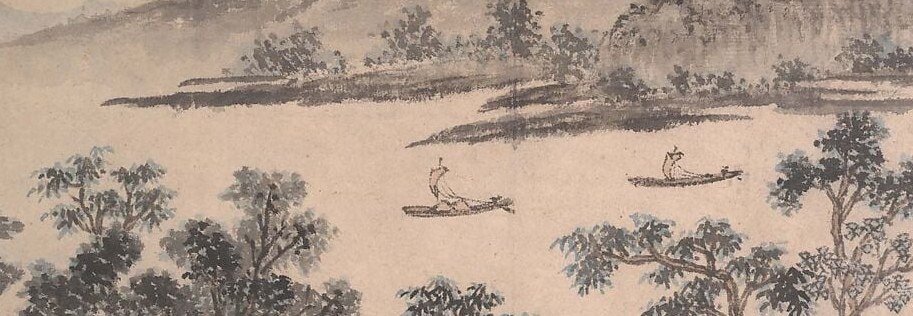
A lone traveler drifts mid-river, dwarfed by the mountain mass on the right bank. A tiny pavilion nestles into the shore, possibly his destination, possibly the place he has already left. The most radical passage is the summit: wet ink dissolves into bare paper, turning absence into mist. The void itself is the atmosphere.
Shen Zhou belonged to the Wu School and spent his entire life in the Suzhou region. He refused the imperial examinations, choosing instead to care for his widowed mother and let brushwork become his real vocation. This painting, executed with swift, fluid strokes on an intimate album leaf, distills the literati ideal: the scholar-recluse seeking emptiness rather than power.
Every visible stroke is a decision about what to leave out. The broad river is nearly blank, yet it holds the whole composition together. Shen Zhou called this approach 'ink play', and it remains one of the quietest arguments for humility ever made in paint.
Details
Transcript
1468. A Ming dynasty scholar refuses the emperor's court. Look how small he is. A lone figure adrift. The ideal life was not power, but retreat. He heads toward that pavilion: a shelter built only for contemplation. A second boat, even smaller, follows the same quiet path. Now look up. The mountain dissolves into the paper itself. Shen Zhou believed the void was the loudest statement a painter could make. He spent his life in Suzhou, caring for his widowed mother, choosing ink over politics.