The Meeting of Antony and Cleopatra by Giovanni Battista Tiepolo
Giovanni Battista Tiepolo's 'The Meeting of Antony and Cleopatra' (1746) is a masterclass in visual strategy, now held at The Metropolitan Museum of Art. The Venetian painter stages a legendary seduction not as a private affair but as a public spectacle, and every brushstroke is a move in a high-stakes political game.
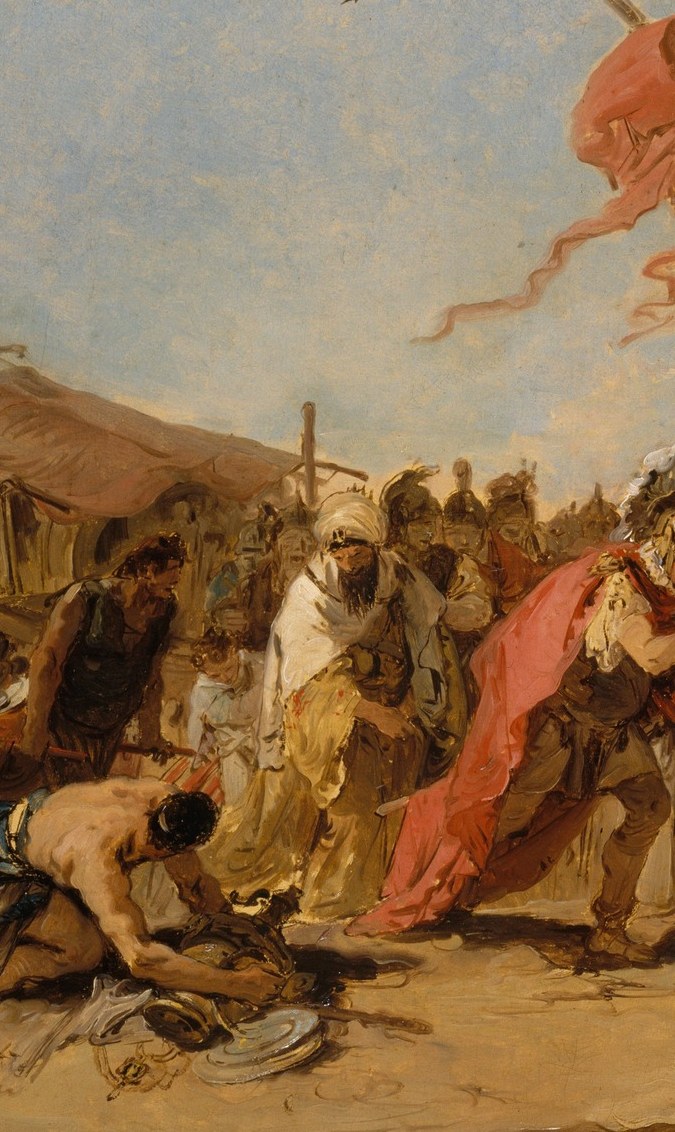
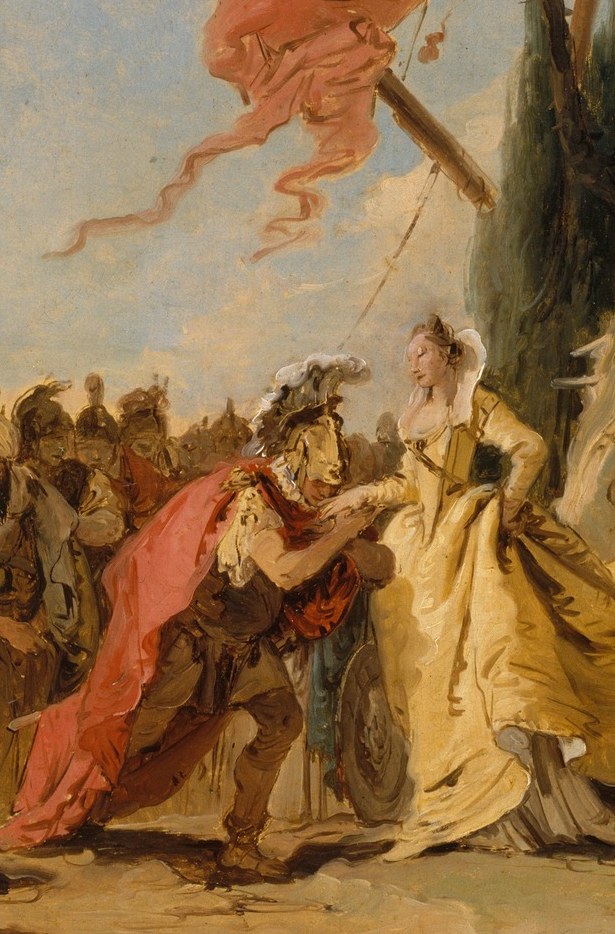
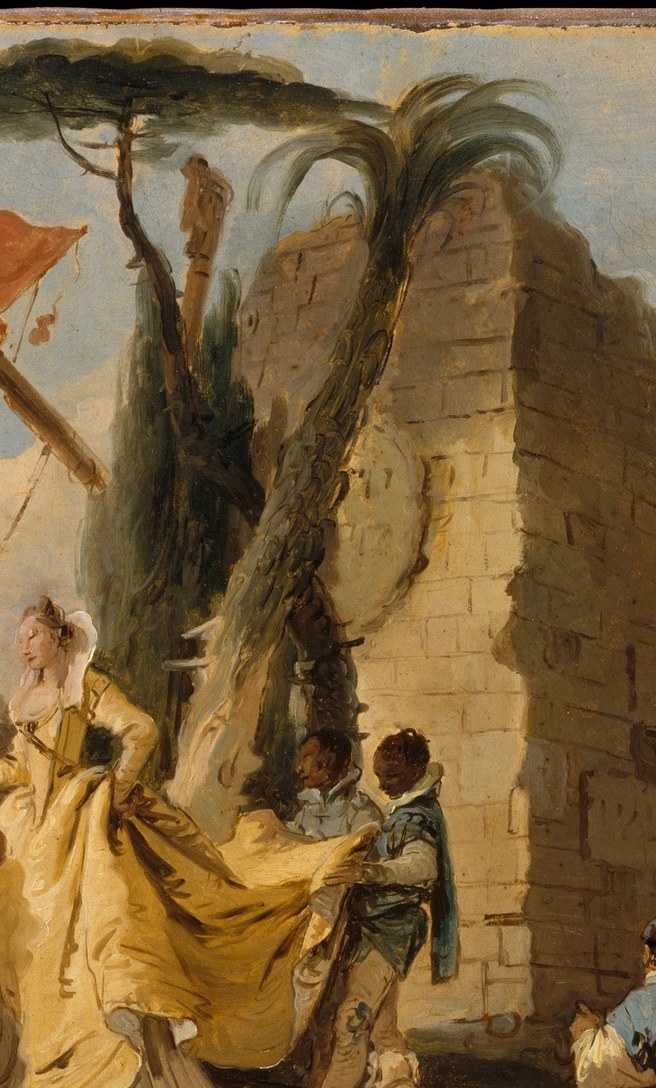
Your eye is pulled instantly to her white gown. Against a sea of warm ochres and earth tones, her luminous silk is an aggressive act of attention-seeking. Look closely: Tiepolo painted that fabric with rapid wet-on-wet strokes, and its radiance depends on the darker, shadowed Roman costumes standing back in submission.
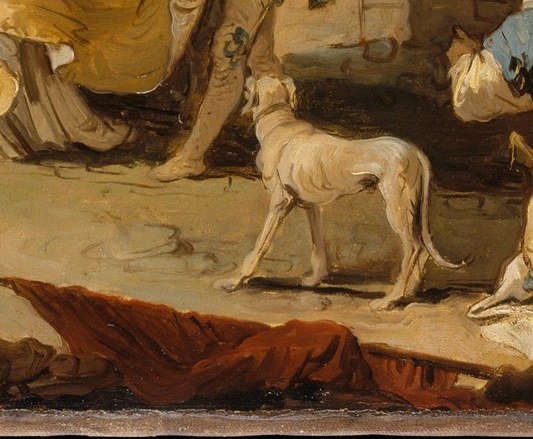
Then find her face beneath the crown. Her expression is the real event here. This isn't a swooning romantic encounter. Tiepolo gives Cleopatra a steady, evaluating gaze directed at Antony, while his body language seems to yield. Down below them, a white greyhound, a classic symbol of fidelity, looks on, anchoring the whole theatrical performance at its lower edge.
The historical meeting, which reshaped the ancient Mediterranean, is painted in 1746 by an artist famous for his soaring Venetian ceilings and frescoes. Here he brings that same operatic scale to canvas. What do you read in her expression: genuine fascination, or the cool calculation of a sovereign who needs Rome's army?
Details
Transcript
A queen steps ashore in a gown of luminous white silk. Tiepolo painted this to make her the only light in the scene. Mark Antony, Rome's general, waits in the shadow of a ruin. His posture gives way. She is already winning. Now look at her face. Poised. Calculating. The hinge on which an empire will turn. The dog at their feet is a symbol of fidelity, watching history.