Botocudo Chief, His Wife, and a Young Man by Catlin, George
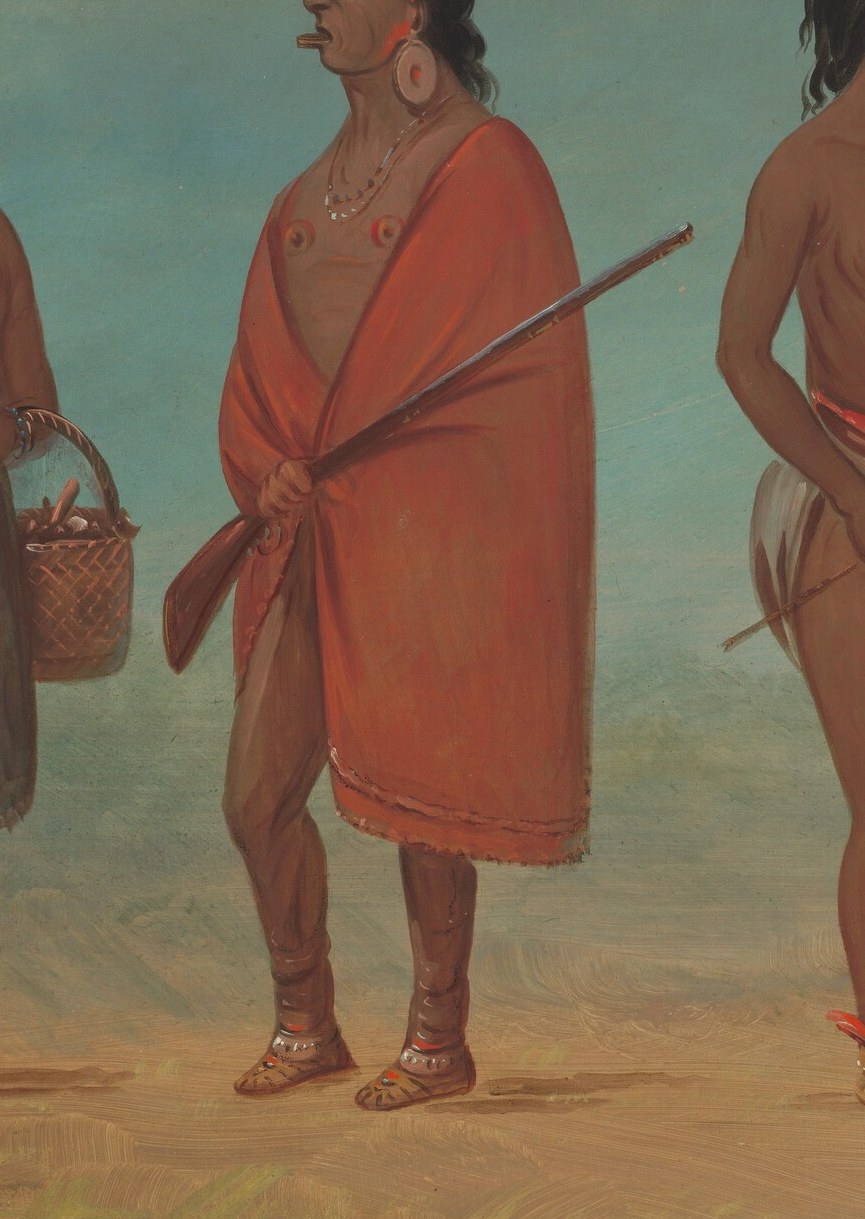
This is George Catlin's 1862 portrait 'Botocudo Chief, His Wife, and a Young Man,' now in the Smithsonian American Art Museum. At first glance, it is a straightforward document of three tribal members, painted by a former lawyer who believed he was recording a disappearing world.
Look at the lower left corner. The small inscription 'A 331' is not an artist's flourish or a collector's mark. It is a physical scar from the painting's own near-death experience.
The painting is oil on card mounted on paperboard, a fragile, informal support typical of Catlin's folk-art approach. In 1952, a fire at the Smithsonian's storage facility damaged or destroyed thousands of artifacts. This small card was pulled from the debris, and the alphanumeric code was applied during the emergency triage to document its rescue.
Catlin made five trips into the American West in the 1830s, creating hundreds of portraits. This later work, executed well after his primary travels, captures a chief's authority in the red robe and spear, his wife's domestic role with her basket and paddle, and a young man's readiness in his bow. The painting itself almost vanished, surviving a modern disaster that makes that quiet inscription the most dramatic detail on the canvas.
Details
Transcript
A chief, his wife, and a young warrior. Painted in 1862 by a lawyer who went West to record what he feared was vanishing. Now look at the corner. A small mark most people scroll past. That is not the artist's signature. It is a salvage tag. In 1952, a fire tore through the museum. This card was pulled from the rubble. The number catalogued its rescue, not its creation. It survived.