Untitled by Katsushika Hokusai
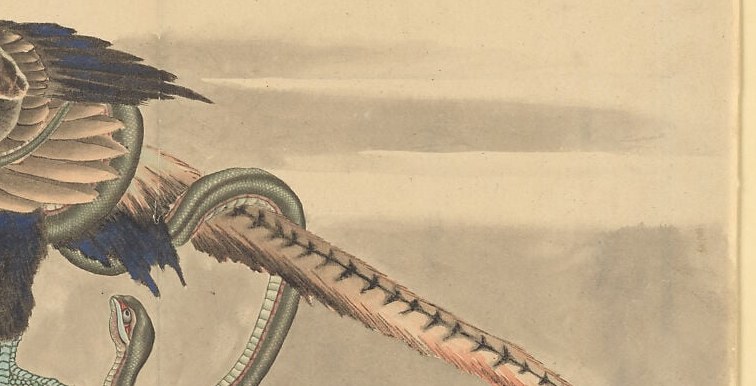
A pheasant mid-flight, a snake coiled around its legs. This is Katsushika Hokusai's Untitled, painted in 1799. At the time, Hokusai was working in Edo, now Tokyo, as a commercial printmaker. He had not yet created The Great Wave off Kanagawa. He was still decades away from calling himself 'the old man mad about art.' But this quick, confident painting already shows his single greatest obsession: capturing the natural world in the split second it reveals itself.
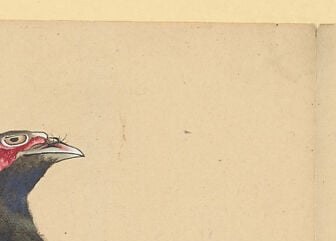
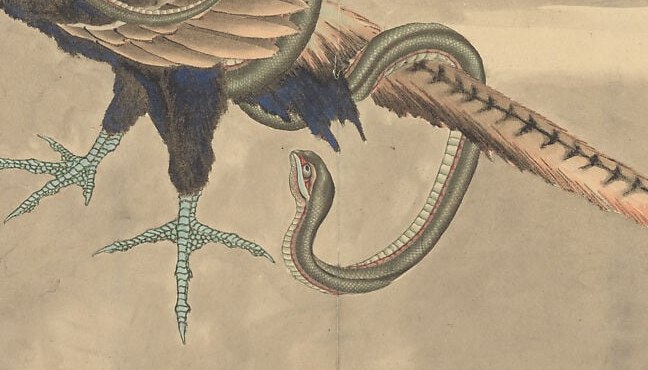
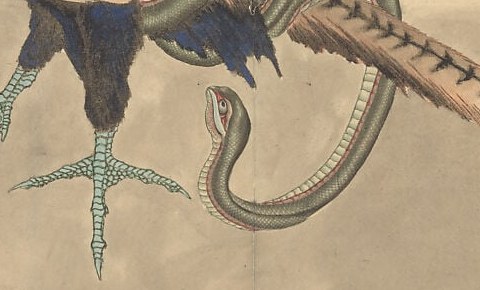
Watch where the camera lands. The pheasant's eye is a single bead of dark ink, alert and open. The snake's scales are built from tiny cross-hatched lines, a technical showpiece in a painting that seems so simple from a distance. Hokusai is not telling a story of gore here. There is no blood. He shows only the tension of the constriction and the vivid red of the bird's wattle against the flat grey wash of the background. The colour on the pheasant's feet, a striking teal green, is the most saturated pigment in the piece, anchoring the violence in a strange, mineral beauty.
This painting belongs to the long Edo tradition of watching the natural world with intense precision. In the late 18th century, Hokusai was part of a cultural moment where artists and poets competed to observe and record birds, insects, and plants in their true form. His quick, uncorrected brushwork on paper suggests he may have sketched from a dead specimen, or from an experience in the field deposited into memory then released onto the page in a few concentrated minutes. The result predates the photographic freeze-frame by decades, but it does the same work.
Hokusai once said he hoped to live to 110, because only then would every dot and line he drew come alive. In this small, tense scene from his thirties, you can feel how long a journey he had already embarked on. What detail holds you longest here?
Details
Transcript
Edo, 1799. Europe was at war; Japan was watching birds. A pheasant caught in a frozen, terrible instant. The snake's coils tighten around its legs. Look at the eye: painted with a single, alert dot of ink. The painter was 39 and called himself 'the old man mad about art.' He rendered the snake's skin with tiny cross-hatched scales. He would spend his whole life perfecting how to draw a single living moment.