Near the Coast by Robert Swain Gifford
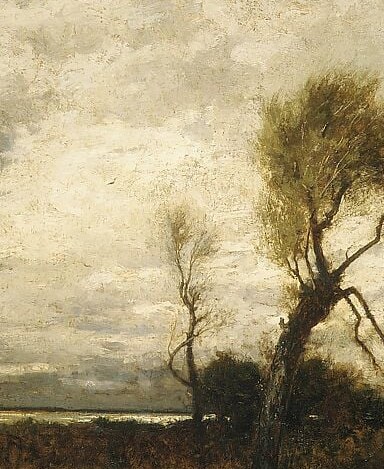
Robert Swain Gifford's 'Near the Coast' (ca. 1885) lives in The Metropolitan Museum of Art, but its real subject is not the dramatic central trees. It is a quiet lesson in looking at the margins of a landscape.
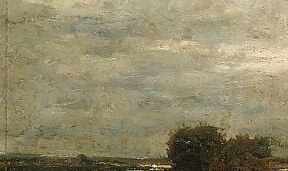
Gifford builds the scene with a classic Luminist device: the brightest value sits at the horizon, pulling your eye deep into the coastal marsh. But then he hides two crucial details in plain sight. On the far left, barely legible, a faint line of trees proves this is not wilderness, someone lives beyond the frame. And in the lower-left corner, a dense dark mass of vegetation anchors the entire composition with its weight.
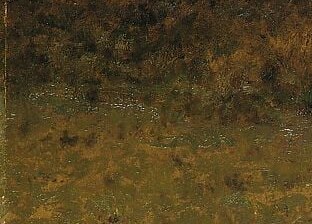
Gifford was a second-generation Hudson River School painter who worked outdoors near his Massachusetts home, chasing the specific light on tidal water. This painting blends that older tradition's precision with the looser touch of emerging American Impressionism. The foreground grasses are the most tactile passage in the work, brittle ochre and sienna strokes that invite you to feel the dry marsh.
Next time you stand before a landscape, give the edges a full minute. The painter often puts the key there, not in the center.
Details


Transcript
This looks like empty coastal wilderness. Wind-sculpted trees hold the center against a heavy sky. Gifford painted this around 1885, near his Massachusetts home. He worked outdoors, chasing the light on water. But the real secret is not the luminous sky. Move to the far left edge, almost out of frame. Faint trees prove a larger world beyond the marsh. And this dark clump anchors the whole foreground.