De Winkel near Abcoude by Johannes Hubertus Leonardus de Haas
De Winkel near Abcoude, painted by J.H.L. de Haas in 1874, looks like a quiet Dutch meadow, but it is a precise document of a fully engineered landscape. The painting hangs in the Rijksmuseum and shows a stretch of polder near Abcoude, a hamlet not far from Amsterdam, at a time when the Netherlands was still actively reshaping its land with drainage and wind power.
Look at the extreme flatness of the horizon: there is almost no topographic relief across the entire scene. That is the signature of a drained polder, land lifted from the water and held dry by a system of ditches, canals, and windmills. The pollarded willows on the left are not wild, their crowns were cropped for osier harvest, as managed as any crop. The windmill on the right is not a picturesque symbol; it is a working pump mill, sitting on a low rise with outbuildings at its base.
De Haas was a specialist. He trained in Amsterdam and Haarlem, joined the artist colony at Oosterbeek, and made his reputation painting livestock, cattle, sheep, goats, with patient, naturalistic attention. This painting was made the year after he moved to Brussels permanently, returning to the Dutch countryside for subjects. The cows in the foreground carry the weight of his skill; the landscape around them carries the truth of how the Netherlands works. This is not a fantasy of rural life. It is a working geography, painted by someone who understood what kept the water back.
Details


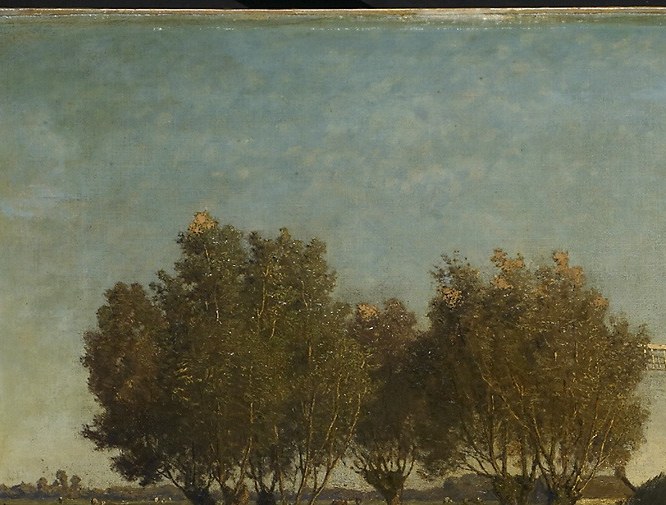
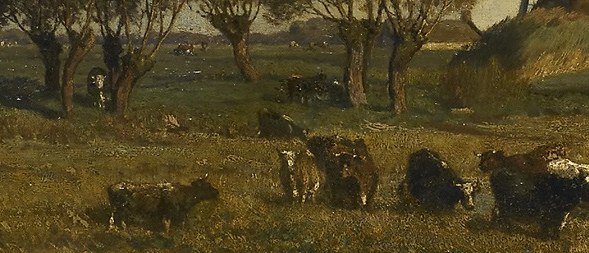
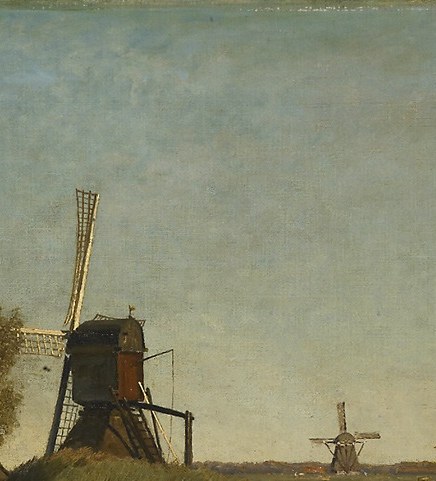
Transcript
This looks like a quiet Dutch meadow. But every inch of this ground was engineered. The polder drops below sea level, held flat by drainage. Pollarded willows line the canals, as managed as the mills. De Haas was known for his livestock, not his landscapes. Yet he captured the exact working geography of his country.