Washington, the Mason by American 19th Century
This is 'Washington, the Mason,' painted by an unknown American artist around 1868. It doesn't show the general in battle, but the man who had already become a symbol. Painted nearly seven decades after his death, it's less a portrait and more a witness to how the nation chose to remember him.
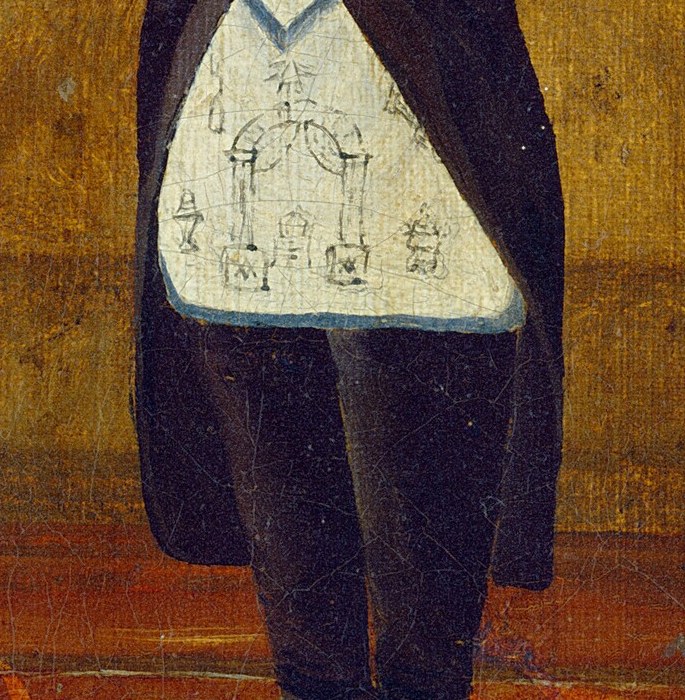
Notice where the entire composition leads: the Masonic apron. The square and compasses on his chest are the visual anchor. Above him, the letter 'G' sits in an arch, a reference to God and Geometry, two pillars of Freemasonry. His outstretched hands suggest he is in the middle of an address to a lodge. Every detail, from the Doric columns to the celestial stars on the floor, constructs a temple of reason and virtue around him.
Washington was a dedicated Mason, and in the years following the Civil War, fraternal orders like the Freemasons experienced a massive revival. They offered structure, ritual, and a sense of moral order in a rapidly changing world. This painting isn't a record of a real event. It's an icon, manufactured by a later generation that needed Washington to be not just a founding political father, but a moral one.
He stands alone in a symbolic space, a figure of authority and calm reason, built from paint and memory for a nation still healing.
Details
Transcript
George Washington died in 1799. This painting came nearly seventy years later. Look at what the painter placed at the center of his chest. The square and compasses. He was a committed Freemason. His hands are open, as if addressing a lodge. The letter above him means God, or Geometry. To the generation after his death, he was more than a president. He was the symbol of a moral and ordered world.