Fair in Brittany by Boudin, Eugène
Eugène Boudin painted 'Fair in Brittany' in 1874, leaving his beloved coastline to capture the quiet commerce of an inland market. The work lives in a modest collection of 19th-century French Impressionism, a small oil on wood panel that holds a big idea.
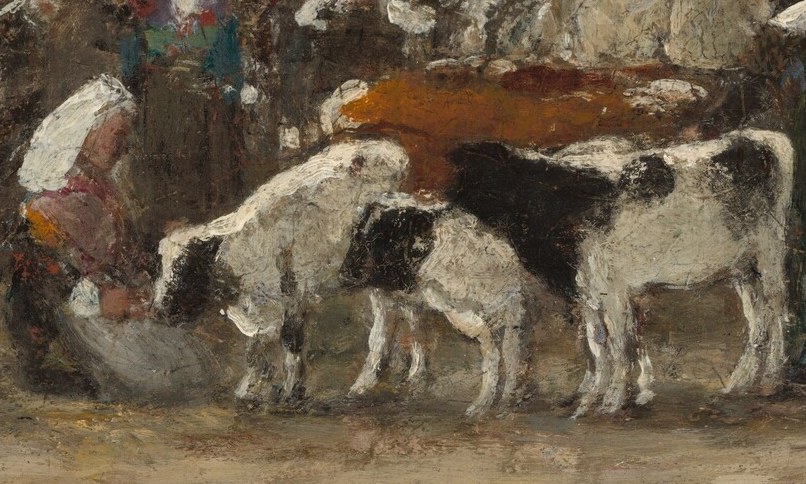
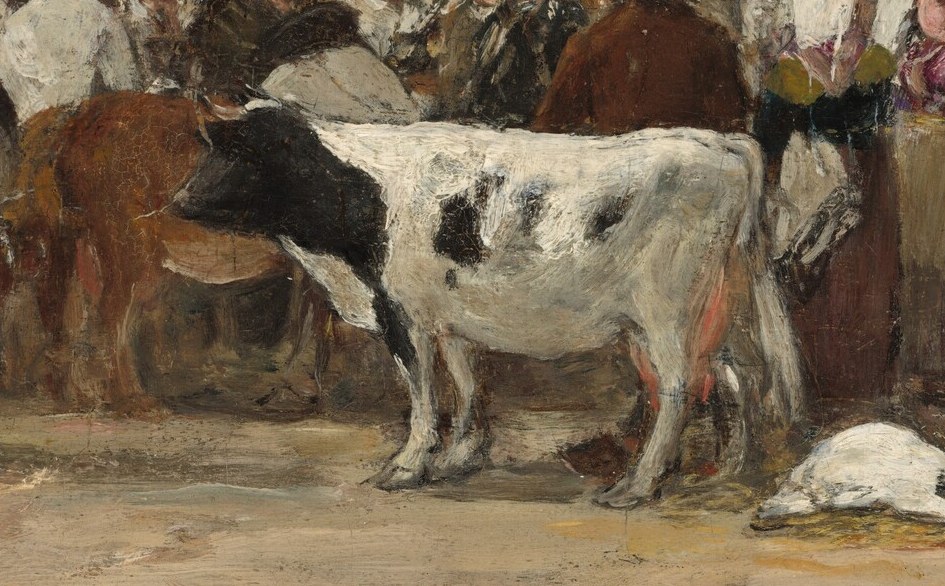
Look past the overcast sky to the figures who give the scene its pulse. A woman in a red hat draws the eye, while another in a white bonnet bends toward a cow in a moment of absorbed labor. Boudin does not idealize them. His brush moves as quickly as the day itself, outlining cows and vendors with a swift, sketch-like touch that feels more like memory than monument.
This was Boudin's radical act. He was among the first French painters to work entirely en plein air, chasing ordinary light and movement long before the Impressionists made it famous. Baudelaire praised his pastels, and Corot named him the King of the Skies, yet here he proves his true allegiance was to the ground-level rhythm of everyday life.
A fair like this lasted only a day. Boudin made sure it would last a little longer.
Details
Transcript
He painted the sea, but here he turned inland. A Breton fair, set under a restless sky. See the woman in the red hat. He used quick, loose strokes to catch the light. Corot called him the King of the Skies. But his real gift was for people just being people. A moment of quiet labor, painted in one sitting.