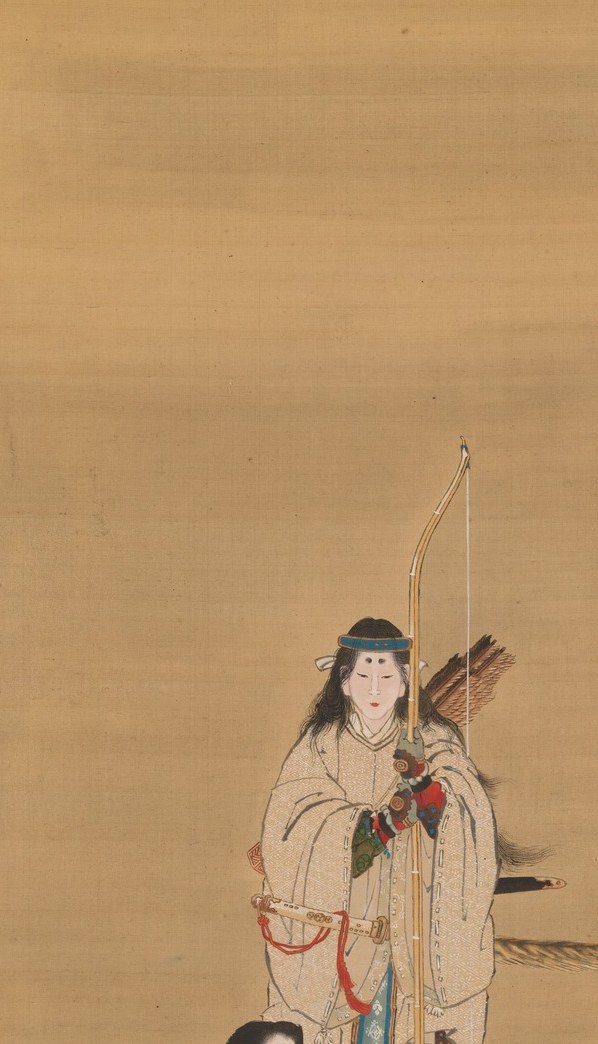
The Legendary Empress Jingū by Hokushin Kosai
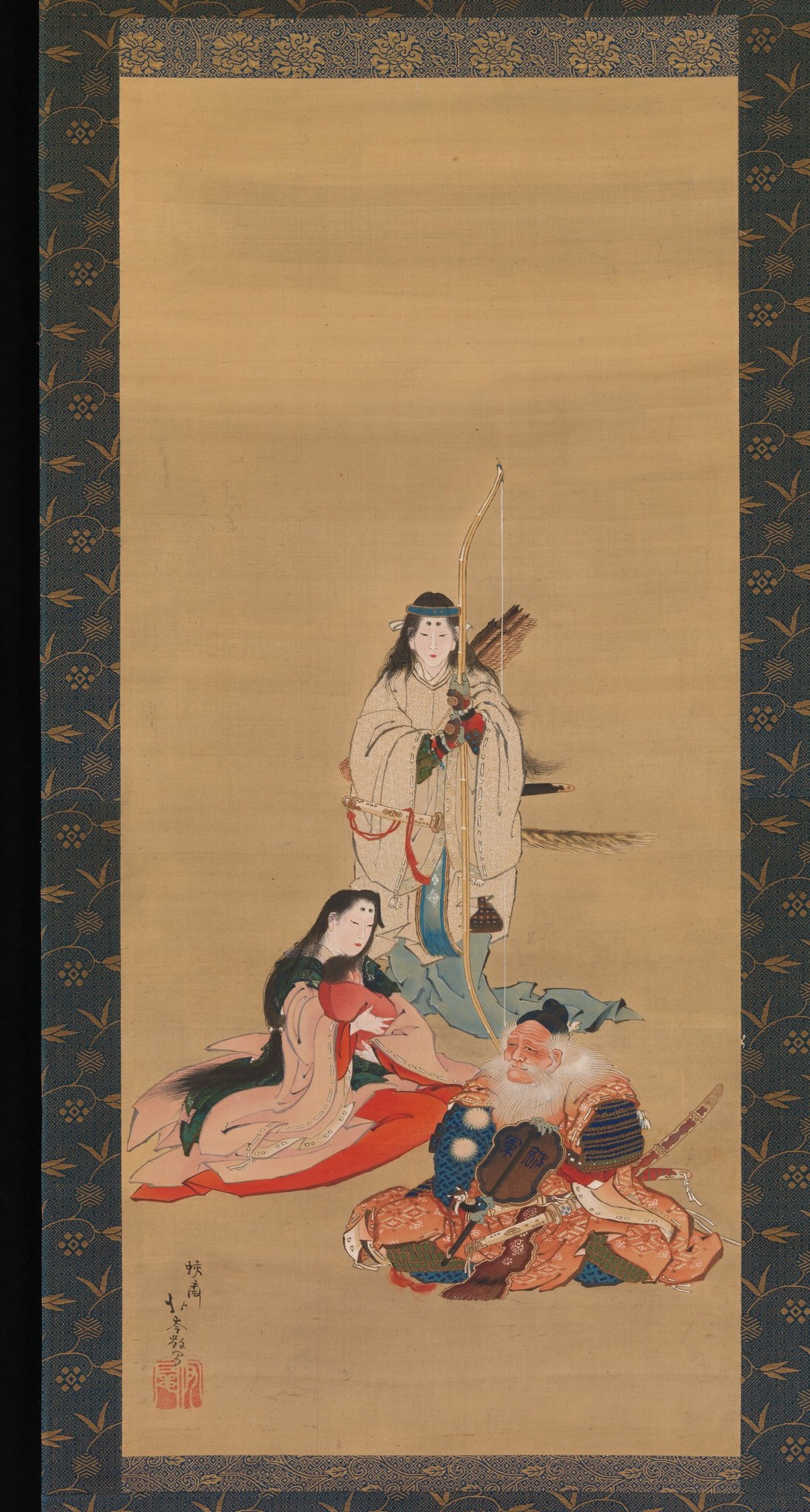
This is Hokushin Kosai's 'The Legendary Empress Jingū' (1850), and it's a miracle it still exists. The painting survived the firebombing of Tokyo in 1945 because its owner buried it underground before the raids. Now in a museum collection, it carries both a myth and a survival story in its pigments.
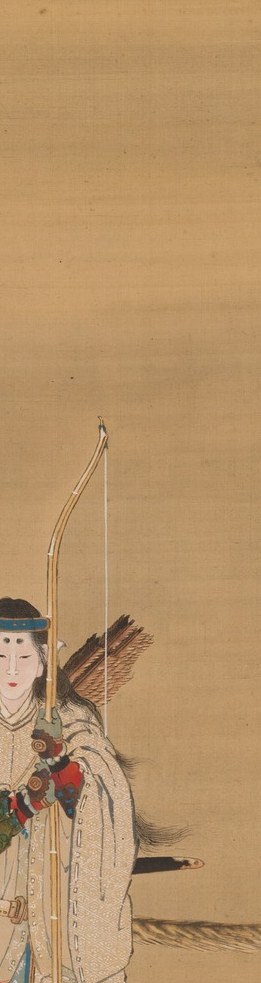
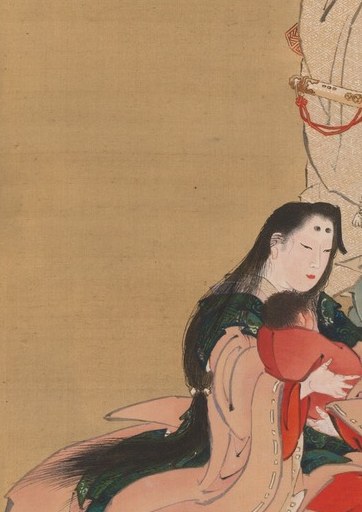
Standing in layered white robes against a flat gold background, Jingū holds a tall ceremonial bow, a striking image in Edo-period Japan, where a woman of imperial rank depicted with a weapon was mythologically extraordinary. Below her, an attendant cradles a swaddled infant, almost certainly Emperor Ōjin, whom legend says Jingū kept unborn through a stone ritual during her Korean military campaign. The kneeling male figure with a fan and scroll acts as a civil witness, recording the moment for posterity.
The gold ground is a direct borrowing from Buddhist icon painting, applied here to Shinto legend. It lifts the figures out of ordinary time and places them in a mythic register. The artist, Hokushin Kosai (1824-1876), worked in a flat, unmodulated style with bright color and no strong shadow, a deliberate two-dimensionality that emphasizes line and ritual over realism.
So much of Edo-period art was lost to war and fire. This one was hidden in the earth and brought back into the light, a painted legend that almost became one itself.
Details
Transcript
Tokyo, 1945. American bombers turned the city to ash. The owner buried this painting underground. It survived because someone believed it mattered. Her face. Composed. A ruler by right, not force. In her hand, a bow. A weapon held by a woman. Legend says she led an army while carrying an unborn emperor. A myth of military and dynastic power, pulled from the flames.