Four Navaho Warriors by Catlin, George
This is George Catlin's 1865 painting, "Four Navaho Warriors," now in the Smithsonian American Art Museum. It is less a portrait from life and more a careful arrangement of coded symbols. Catlin, a lawyer-turned-painter, spent the 1830s traveling the American frontier to document Indigenous cultures he feared would soon be erased by westward expansion. This work came decades later, drawn from memory and his vast collection of sketches.
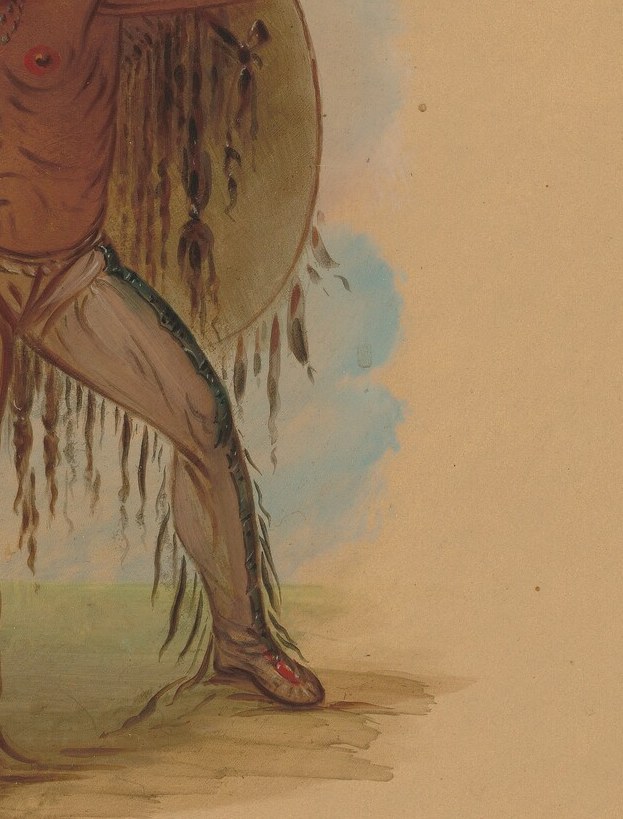
Look past their calm faces. The third warrior holds a staff topped with an effigy bird, a sign of spiritual authority and ceremonial knowledge within Navajo tradition. The rightmost warrior points beyond the frame, a gesture of vigilance, while his shield displays geometric patterns that function as a personal protective emblem. Every object they carry was chosen to signal a specific kind of power.
Catlin created this as an act of historical preservation. By 1865, the Navajo had endured the forced displacement of the Long Walk. His brushwork places these four figures against a blank, timeless background, isolating their dignity from any specific battleground or hardship. The inscription "A. 1865" anchors them in a year of consequence.
When you see a warrior pointing, or a staff crowned with a bird, you are looking at a language of status and protection that Catlin wanted the world to remember.
Details
Transcript
Four men, nearly identical in size and posture. They were painted not from life, but from memory. The third man holds a staff topped with a carved bird. For the Navajo, a bird effigy on a staff signals a spiritual leader. The pointing finger leads the eye to an unseen threat. His shield carries geometric symbols, a personal protective code. The artist was a lawyer, recording a culture he believed was vanishing.