The Races by Degas, Edgar
This is Edgar Degas's *The Races*, painted around 1871 to 1872 and now in the collection of the National Gallery of Art. Though Degas is most famous for his dancers, his racecourse scenes belong to the same steady investigation of movement, discipline, and modern leisure.
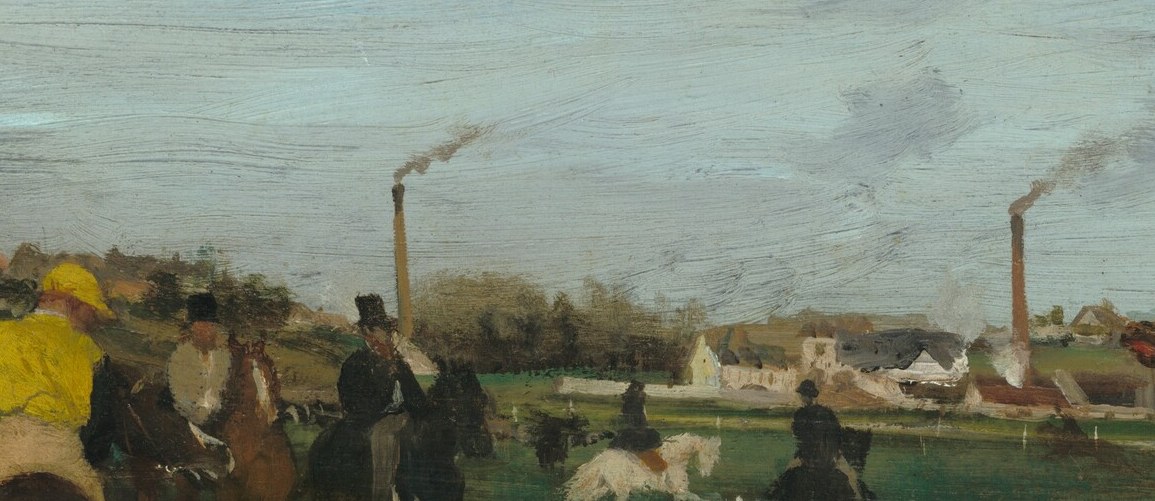
Look first at the jockeys' silks, bright yellow and green against a turbulent sky. A dark horse edges forward, a single instant of shift before the race breaks open. Behind them, Degas placed a distant cityscape of smoking chimneys, the quiet industrial frame around this pastoral field.
The picture was painted in the aftermath of the Franco-Prussian War, as Paris rebuilt itself and a new middle class sought out entertainments like the races at Longchamp. Degas, who called himself a realist, did not paint this outdoors but reconstructed the scene in his studio, relying on his superb draftsmanship and memory of motion.
His horses and jockeys carry the same concentrated line as his ballet dancers: caught not at the climax, but in the tense, ordinary instant just before it.
Details
Transcript
France, 1872. A new middle class has money and time. This field is one of their pleasures: the Longchamp racecourse. Beyond the track, factory chimneys smoke. Paris is bursting its edges. Degas gave these riders the same serious line he gave dancers. A dark horse pulls slightly ahead. The race is about to tip. He painted this not outside but in the studio, from memory and study.