Return of the Redwing by Allen B. Talcott
Allen B. Talcott’s “Return of the Redwing” (ca. 1900) is not a painting that announces itself loudly. It’s a modest oil on wood, an overcast view of a Connecticut meadow, made by an artist who died at 41 and whose name is not widely known outside the circle of American Tonalism. Yet it rewards the viewer who stops long enough to notice what the title is actually saying.
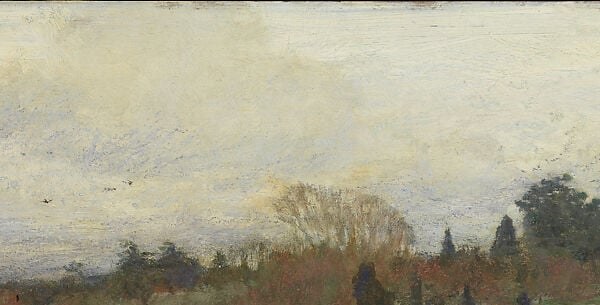
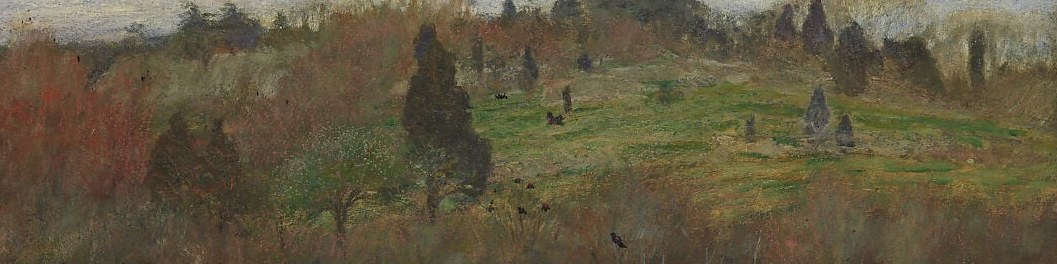
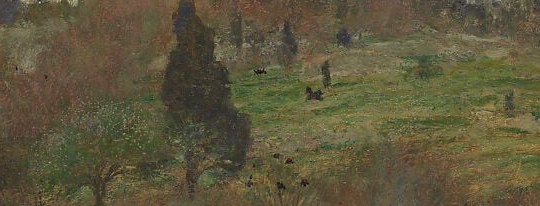
Talcott was a founding member of the Old Lyme art colony, and for eight summers he painted these fields. Here, the first thing the eye finds is the bare winter canopy, Talcott was known for his trees, and you can see why. But the real subject is nearly invisible: scattered across the mid-ground meadow are tiny dark shapes, the returning redwings. The title sends you searching, and the search itself becomes the experience of the painting.
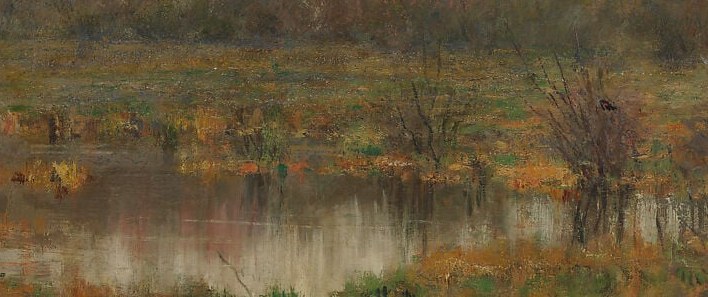
The quiet light, the sourceless oyster-gray sky, the soft dissolve of reeds into still water, all of it is rooted in the Barbizon and Tonalist traditions Talcott absorbed during his training in Paris. He worked outdoors, capturing this specific place with loose, confident brushwork that feels entirely unforced. There’s a ghost-image of the winter trees reflected in the pond, a detail that deepens the reflective mood.
Talcott died at Old Lyme in 1908, at just 41. What he left behind are paintings like this one: understated, deeply felt records of a landscape he clearly loved. The redwings are still returning every spring.
Details

Transcript
A quiet, overcast field in Connecticut, around 1900. The painter returned here for eight summers. He was known for his trees. Now look at the title: Return of the Redwing. The redwings are down here, scattered in the grass. Easy to miss. They reward patient looking. Allen B. Talcott died at Old Lyme three years later. He was 41.