Familien Nathanson by Christoffer Wilhelm Eckersberg
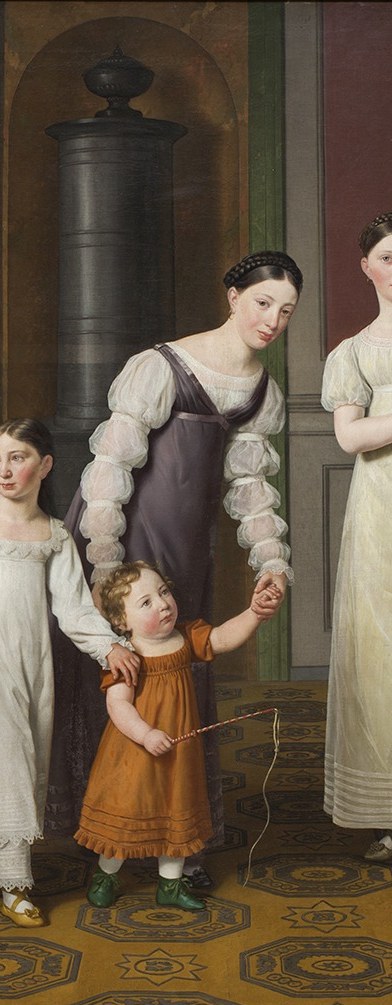
Familien Nathanson, painted in 1818 by Christoffer Wilhelm Eckersberg, is a masterclass in crowd control. The Danish artist, often called the Father of Danish painting, faced a real problem here: ten family members in one room, with a loud geometric carpet threatening to swallow the picture. His solution is a lesson in how color and bodies can steer the eye through visual chaos.
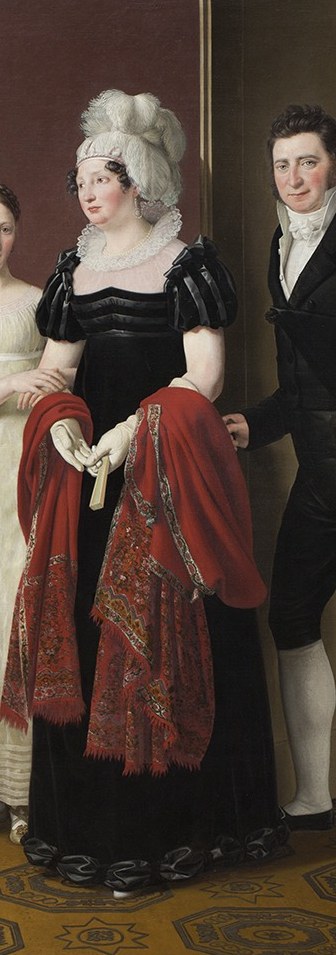
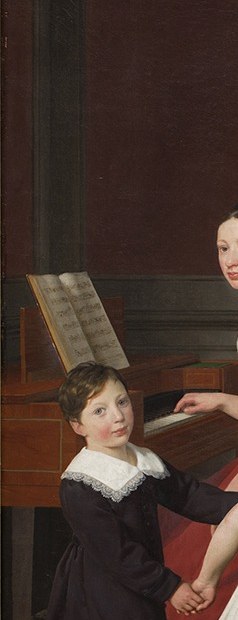
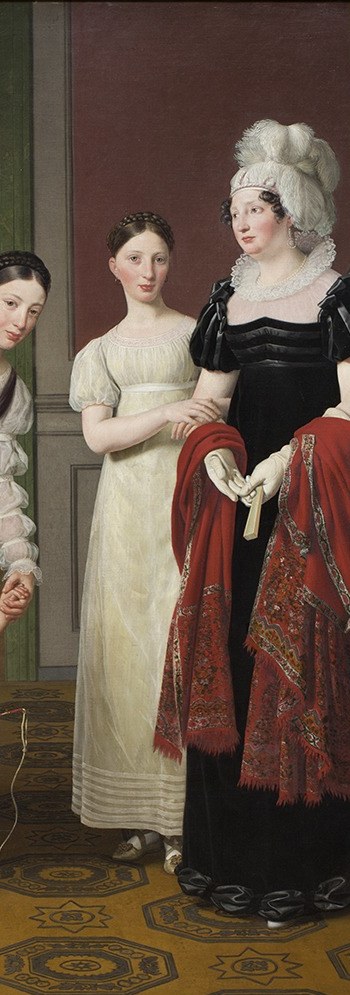
Look first at the tall woman in white at center. She is the spine. Every other figure arranges itself around her vertical line. Then find the single warm-red shawl on the figure near her. Eckersberg scattered strong color accents, white here, black there, that one red, with surgical precision. The red arrests your gaze and prevents it from sliding out the door next to the standing patriarch. Finally glance at the far left edge, where a boy stands beside a music stand. That dark lectern of sheet music acts as a visual bookend, balancing the dark-coated Mendel Levin Nathanson on the far right.
The painting captures the Nathansons, a prominent Jewish merchant family in Copenhagen, in their domestic interior. The detail of the sheet music is not just compositional ballast; it signals the family's cultivation and bourgeois aspiration. Music literacy was a prized marker of education in these circles. Eckersberg rendered the crispness of the white empire-waist dresses, the softness of the children's hair, and the hard geometry of the carpet with equal clarity, using the precise, warm naturalism that defined the Biedermeier style and laid the groundwork for Denmark's Golden Age of painting.
Next time you see a group portrait, notice where the red is. A painter often places it not where it would naturally be, but where the composition demands a full stop.
Details

Transcript
Ten people, one room, and a pattern that could wreck it all. That floor is a visual trap. Bold geometry right up against ten sets of feet. Yet your eye never trips. Eckersberg built a spine right through the center. She anchors the whole group. Everyone else arranges around her. He placed three color-keys to lock the composition fast: white, red, black. Remove the red shawl, and your eye would drift straight out the door. The sheet music at far left pulls weight back to balance the patriarch at right. A family so large it nearly breaks the frame, held together by pure visual engineering.