Shooting the Rapids, Saguenay River by Winslow Homer (American, 1836–1910)
Winslow Homer's 'Shooting the Rapids, Saguenay River' (1905-10) is not really about danger. The painter, well into his seventies, had spent decades watching guides and woodsmen. He knew the difference between a novice fighting the current and a professional reading it. The painting hangs in a private collection, rarely seen in public.
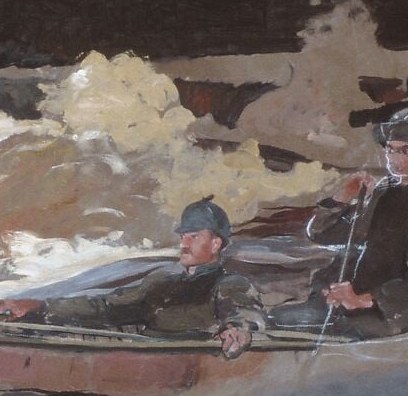
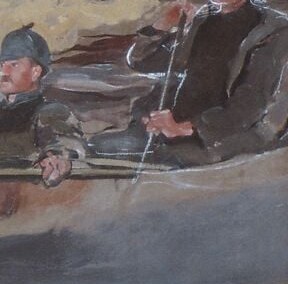
Watch the stern paddler's blade. It is a correction stroke, not a power stroke. The angle reveals a small, precise adjustment to hold the line. The chaos of the white foam around him is not a threat to this man; it is a surface he understands.
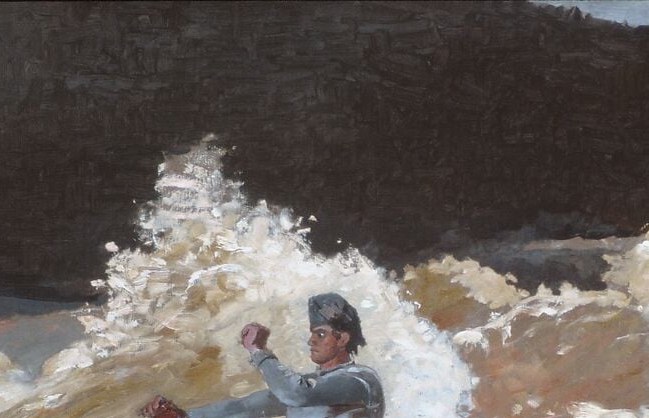
Homer was deeply unfashionable by the end of his life. Critics called his late oils 'coarse' and 'unfinished'. They missed the point. The loose, directional strokes in the rapids do not describe water from a distance; they describe what water actually looks like when you are in it.
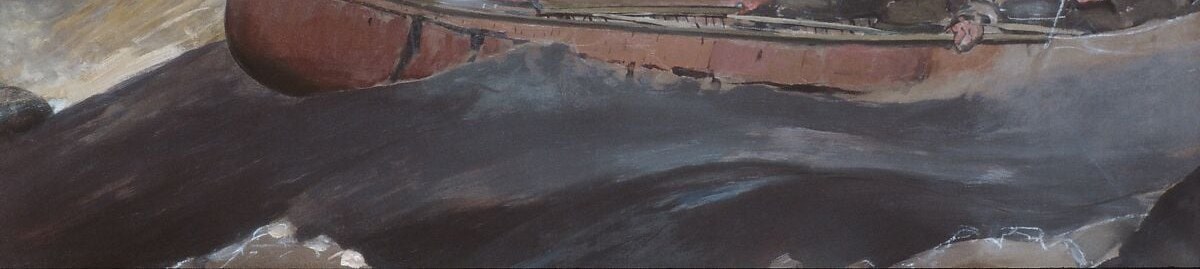
The canoe is the spine of the composition, running diagonal against the dark Laurentian treeline. Everything in the frame is in motion except the trees and the man's concentration. Where do you feel the real weight of the river, in the bow parting the spray, or in that deep, near-black water in the foreground?
Details
Transcript
They look in control. The stern paddler sets the course. His blade is not a power stroke. It is a correction. Homer knew real canoeists. He watched them in the Adirondacks for years. He painted this in his seventies, after the critics had called his work crude. But look at the foam. Loose, directional, never frozen. Homer was not after a pretty picture. He was after the thing itself.