Peaceful Valley by Wyant, Alexander Helwig
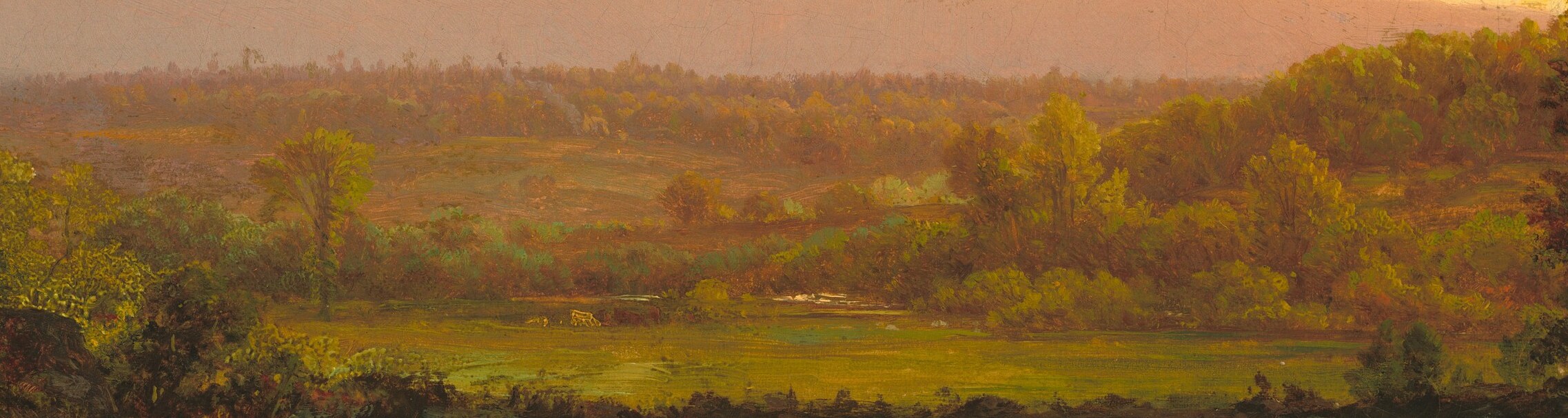
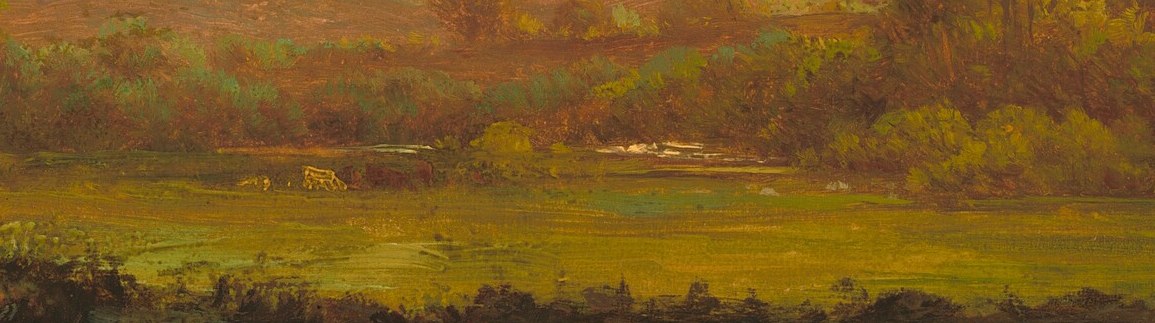
This is Peaceful Valley, painted around 1872 by the American landscape artist Alexander Helwig Wyant. On first glance, it is a simple, unpopulated scene of a green field beneath a warm sky. But hidden inside a glowing patch of light in the middle distance is the artist's signature, tucked into the paint like a secret. That choice of placement has meaning.
Look at the brushwork. The foliage on the left is built with thick, textured strokes that sit on top of the canvas. The sky shows the same visible hand. Wyant began his career in the detailed tradition of the Hudson River School, but by the early 1870s his style was loosening dramatically, moving toward the softer, atmosphere-driven mood of American Impressionism.
The reason for that shift is sobering. By 1872, Alexander Helwig Wyant was losing his eyesight. Fine, precise detail was no longer physically possible for him. Rather than stop painting, he adapted. He came to rely on memory and broad, tactile handling of paint, turning a limitation into the very thing that defines his most admired work. The signature hidden in the light is less a mark of ego than a quiet statement: I was here, in this glowing field, seeing what I could still see.
Next time you look at a landscape, ask where the artist might have hidden themselves, not in the foreground, but in the light.
Details

Transcript
It looks like a quiet, empty valley at dusk. But scan the sunlit field in the middle distance. Find the brightest, almost glowing patch of green. Hidden in that light is an inscription: A.H. Wyant. By 1872, when he painted this, Wyant was going blind. His late work trades fine detail for thick, visible brushstrokes.