Old Manor of Criqueboeuf by Homer Dodge Martin
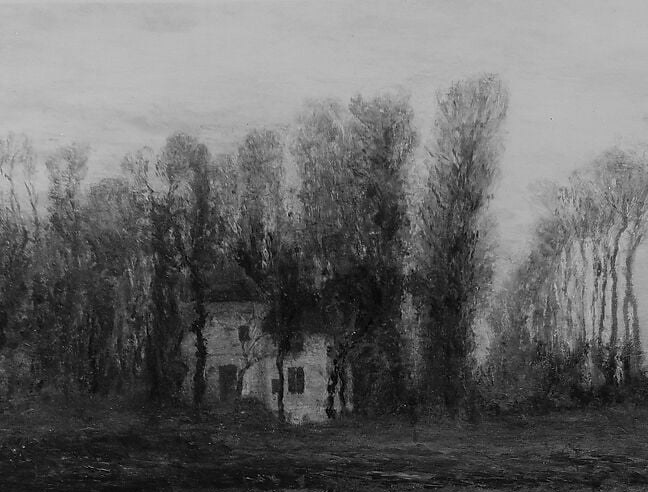
Old Manor of Criqueboeuf (ca. 1882-92) by Homer Dodge Martin is a painting of a manor house in Normandy, but its true subject is the extreme stillness of a winter atmosphere, and the heartbreaking reason it looks this way.
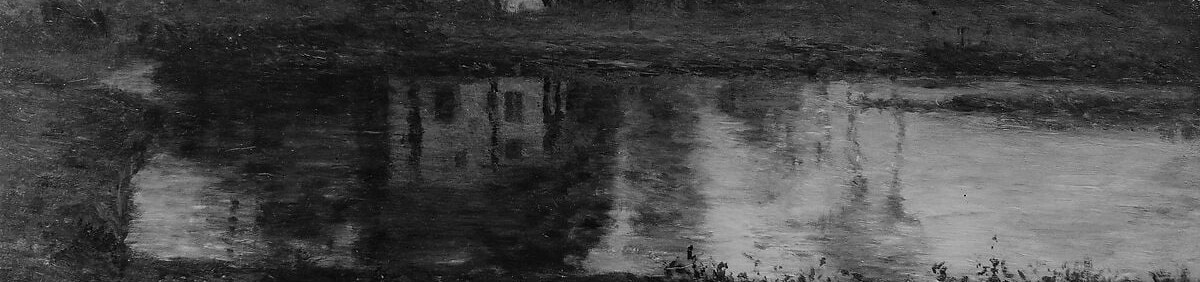
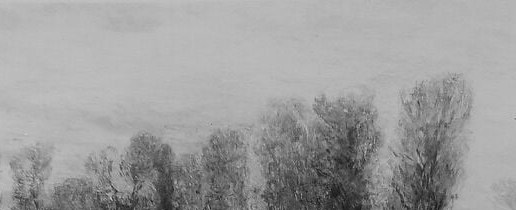
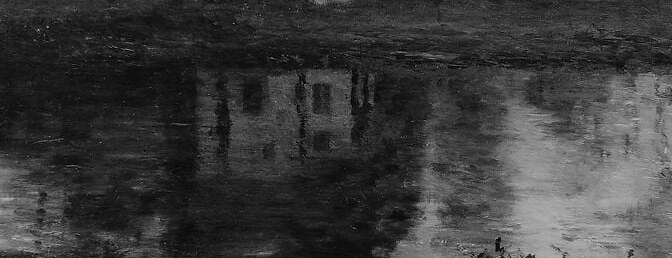
Martin painted this in the last decade of his life, as his eyesight was failing. Where his earlier work was detailed and literal, his late paintings compress the landscape into broad planes of near-monochrome tone. Here, a dense grove of bare trees fills the upper center, and its inverted reflection in still water doubles the visual mass, making the branches seem to grow both upward and downward. The most exquisite passage is the uppermost filigree of twigs, which dissolve into the pale sky with an almost watercolor delicacy.
The location is Criqueboeuf in Normandy, but the painting lives in the American Wing of the Metropolitan Museum of Art. Martin was a central figure in the shift from the Hudson River School’s grandeur toward a more intimate, tonalist approach, influenced by the French Barbizon painters. His late work was often misunderstood in his lifetime, too vague, too quiet, but it is now seen as the deepest expression of his vision, achieved as that vision physically faded.
There is something quietly staggering about an artist who, as the world goes dim, paints not what he sees, but what it feels like to see. The manor is barely present, its reflection even more ghostly. Solidity dissolves into air.
Details

Transcript
This painting nearly vanished twice. Once when its painter started going blind. And again when he painted it anyway. Look at the trees dissolving into the sky. He built the whole world twice, up and down. His failing sight forced him to abandon detail for pure atmosphere. Almost no color. Just a spectrum of gray and ochre.