Banks of the Loing by William Lamb Picknell
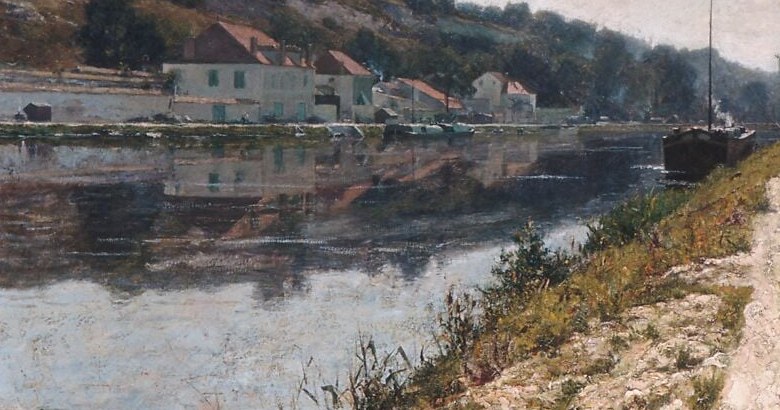
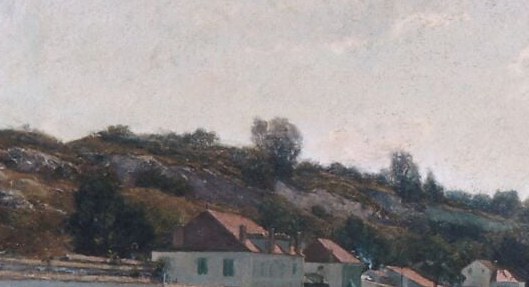
This is 'Banks of the Loing' by the American painter William Lamb Picknell, painted in France around 1894-97. It now hangs in the Met's American Wing. The painting works an optical trick: up close, the brushwork is astonishingly loose, almost abstract. Step back, and those scattered marks resolve into something perfectly still, a mirror-smooth canal reflecting the sky.
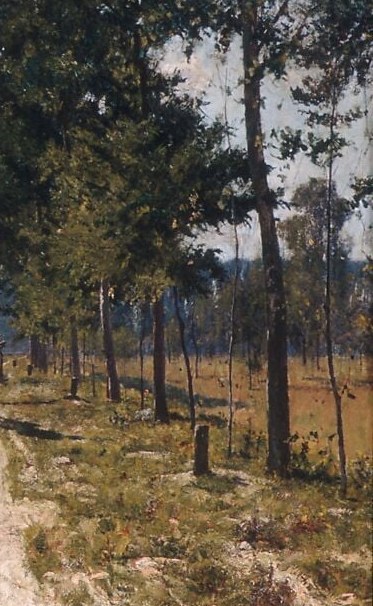
Picknell was a plein-air speed demon. He prided himself on finishing a canvas in hours, not days, which forced him to paint with slashing, confident strokes. Look at the poplar trunks on the right bank. At nose-length, they are just thick smears of impasto. At a distance, they become solid wood, anchored in the sandy towpath.
Though he painted this on the Loing River in north-central France, where he lived for years, Picknell was homesick. He was born in Vermont, and the painting feels like it. The white farmhouses tucked into the left bank, the enveloping calm, the soft overcast light, this isn't the dramatic French countryside of the Impressionists. It is a quiet, unassuming landscape that reads as distinctly American.
The story has a sad end. Picknell died in Marblehead, Massachusetts, in 1897, at just 43 years old. His life had been a restless one, moving constantly between Europe and New England. When he died, his finances were so tight that his last, unfinished painting was sold to pay for the funeral.
Details
Transcript
This painter was known for his astonishing speed. He could finish a canvas outside in just a few hours. Up close, his brushwork nearly dissolves into pure paint. Step back, and those strokes lock into a glassy, motionless canal. That technique gave the painting its hush. He painted this in France, but he was homesick for rural New England. So he gave the Loing the quiet of a Vermont morning. He died at 43. The final frame on his easel was sold to settle the funeral.