Mandan Village - A Distant View by Catlin, George
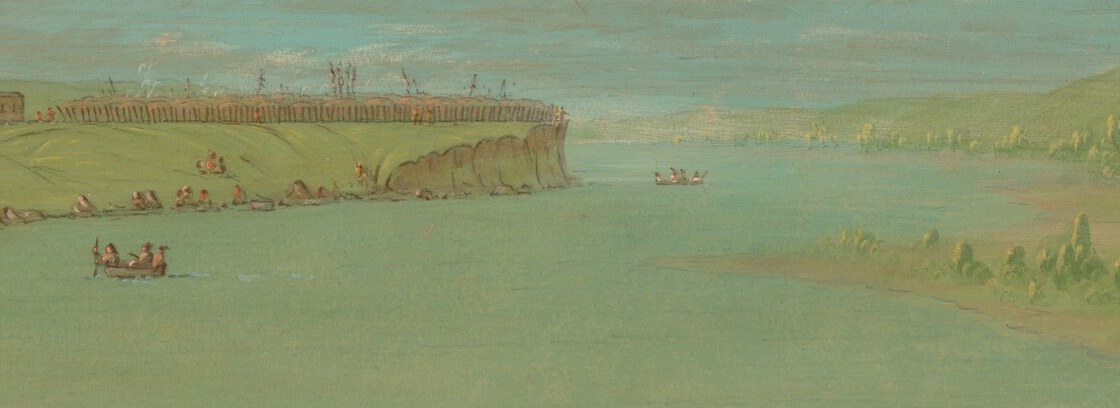
George Catlin painted Mandan Village - A Distant View in 1865, thirty years after his final journey up the Missouri River. By then, the Mandan communities he had known were devastated by smallpox. He painted this from memory, a lawyer turned artist who believed his life's purpose was to preserve what he called a 'doomed race' on canvas.
Look at the fishing rod in the foreground. The line is barely visible, a single thread holding a moment of patience. The seated figures on the bank are not posed heroes; they are people in the middle of an ordinary afternoon. Catlin does not dramatize them. He simply records the way the light falls on the river and the quiet shape of a boat crossing the water.
Catlin made five expeditions in the 1830s, creating over 500 paintings and collecting artifacts. He later assembled them into his Indian Gallery, which he toured across the United States and Europe. He spent his final years trying to persuade the U.S. government to purchase the collection intact. Congress refused, and it was eventually bought by a private collector after his death. The painting here, a small oil on card, was acquired by a regional museum in the early twentieth century.
This is not a grand history painting. It is a witness. Someone fished. Someone rowed. Someone stood on the bank and watched the sky. Catlin wanted you to know they were here.
Details
Transcript
He was a lawyer who left his practice to paint. In the 1830s, George Catlin traveled the frontier five times. He knew these communities were being erased by westward expansion. So he painted a quiet day on the river. A thin line drops from a fishing rod into the water. Everything here would be gone within a generation. A small boat travels the river, connecting one life to another. All that remains of their world now is this quiet afternoon.