Untitled by Bhima|Kesu Ram|Bhopa|Nathu
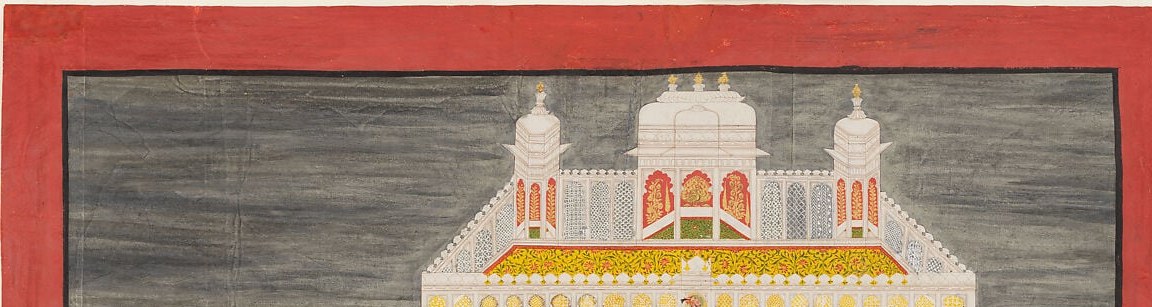
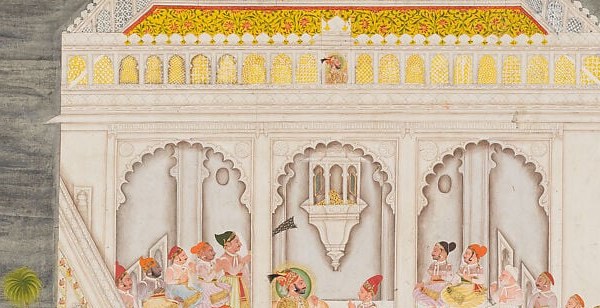
This 1767 court painting depicts Maharana Ari Singh of Mewar presiding over a monsoon festival at the Jagniwas Water Palace in Udaipur, and then it depicts him again. Four artists collaborated on the work: Bhima, Kesu Ram, Bhopa, and Nathu, with Bhima understood to be the principal hand.
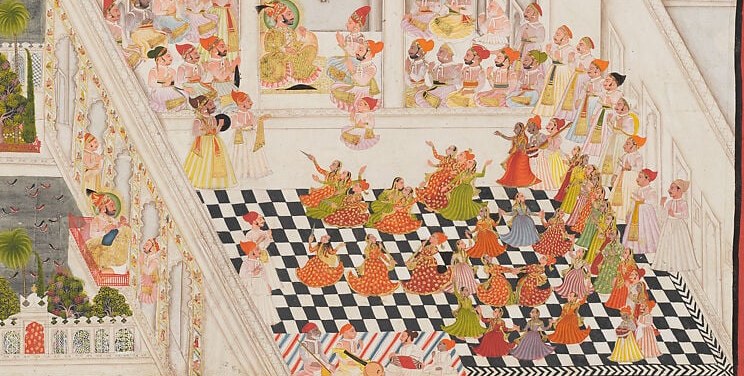
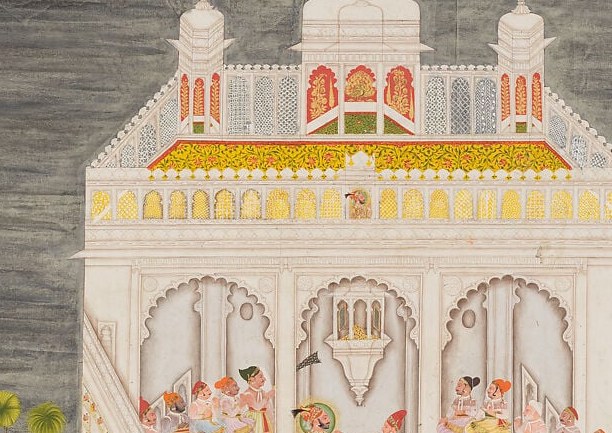
The painting splits the ruler into two selves. In the main hall he appears enlarged, surrounded by chiefs arranged by formal rank, watching dancers on a black-and-white checkerboard floor. The composition itself is a dynastic org-chart in paint: scale and seating position encode political hierarchy. Then the eye finds the lower-left corner, where the same Maharana sits alone beside a fish pool, framed by tiny wall paintings of erotic scenes and Vishnu's ten avatars. It is a dual portrait, public sovereign and private man in one sheet.
This was a transitional moment for Mewar painting. Around 1710, Mughal naturalism began entering Rajasthani workshops, bringing detailed architecture, receding space, and secular everyday subjects. The artists here absorbed those imperial techniques but kept the saturated color, multiple viewpoints, and symbolic scale of their own tradition. The Met acquired the painting in 1994 through a group of donors honoring Mr. and Mrs. Gustavo Cisneros.
A painting-within-a-painting, a ruler shown twice, how many viewers in the 18th century were meant to see that second Maharana, alone with his garden of secret images?
#arthistory #rajputpainting #mewar
Details
Transcript
In the main hall, the Maharana sits larger than everyone around him. Size is rank. Every courtier is seated by proximity to power. Below, dancers move across a checkerboard courtyard. But now look to the lower left. The Maharana appears again. This time he is alone beside a fish-filled pool. On the walls around him: paintings of erotic scenes and the ten avatars of Vishnu. One ruler, two selves, the public sovereign and the private man.