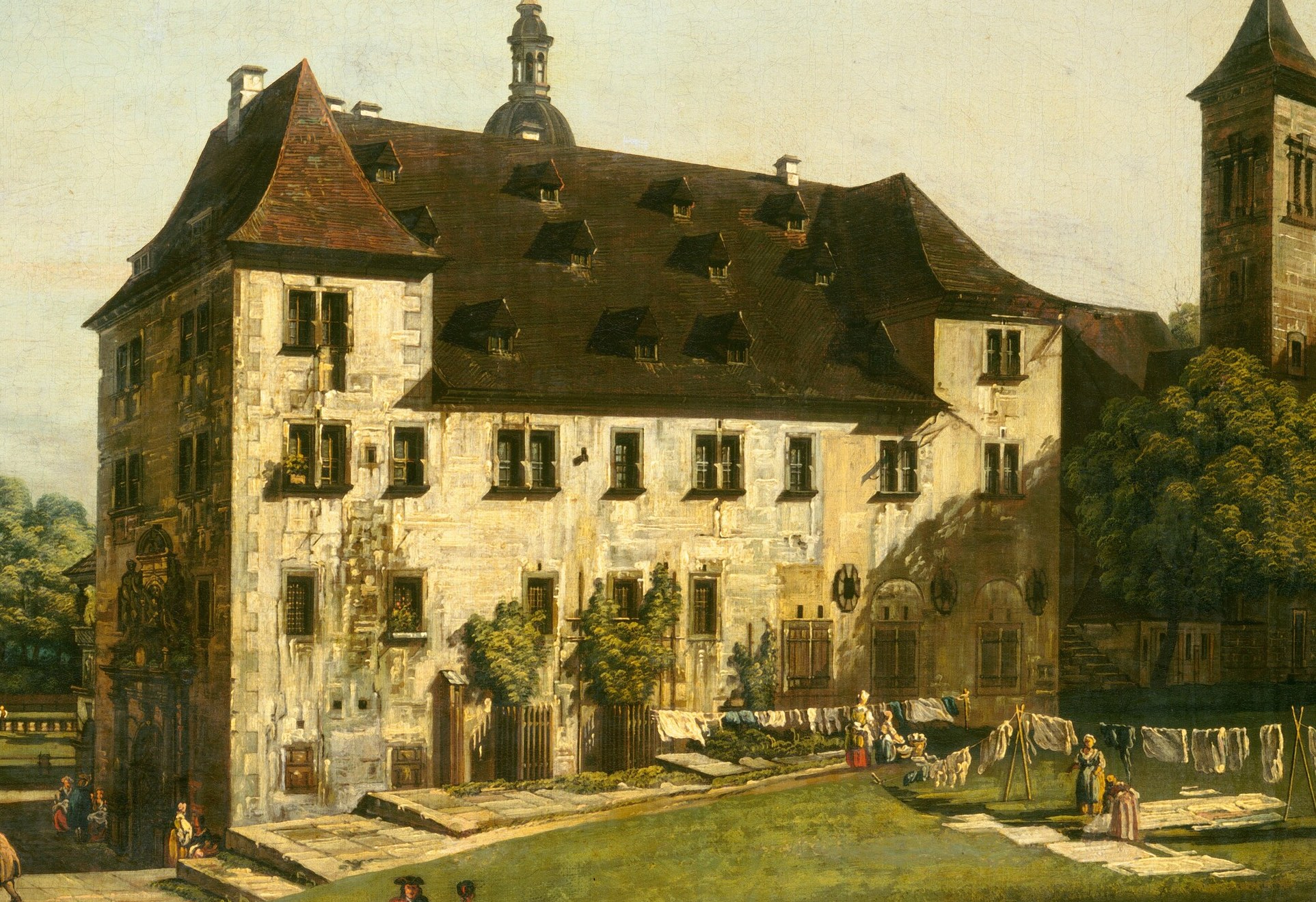
The Fortress of Königstein: Courtyard with the Magdalenenburg by Bellotto, Bernardo
This is Bernardo Bellotto's 'The Fortress of Königstein: Courtyard with the Magdalenenburg,' painted around 1757 and now held in a public collection. The painting does far more than record a Saxon fortress, it delivers a carefully constructed political argument through everyday objects most viewers scroll past.
Watch the woman with the parasol, the laundry workers, and the man in the red coat. In 18th-century visual language, a parasol signified peacetime leisure, clean linen hanging in a courtyard meant domestic order, and a red coat identified a magistrate, civilian authority, not a soldier. Together, those three details transform the scene from a simple veduta into a statement of governance.
Bellotto was Canaletto's nephew and trained in Venice, but he spent most of his career in the courts of Dresden, Vienna, and Warsaw. His reputation rested on topographical precision: patrons commissioned him to show their cities and fortresses as they actually looked. But accuracy never meant neutrality, and this painting of Königstein was a diplomatic gift, an image of a fortress that needed no army because it was ruled by peace and law.
Every fortress painting claims something. This one claims that the real defense is good government.
Details

Transcript
A fortress courtyard on an ordinary afternoon. Look at the woman with the parasol. In 18th-century code, a parasol means peace. Now the laundry. This is not random. Clean linen signals domestic order inside the fortress walls. The man in red stands alone, watching the gate. A red coat marks a magistrate. Civilian authority, not military. The message: Königstein is governed peace, order, and law.