A Small Lengua Village by Catlin, George
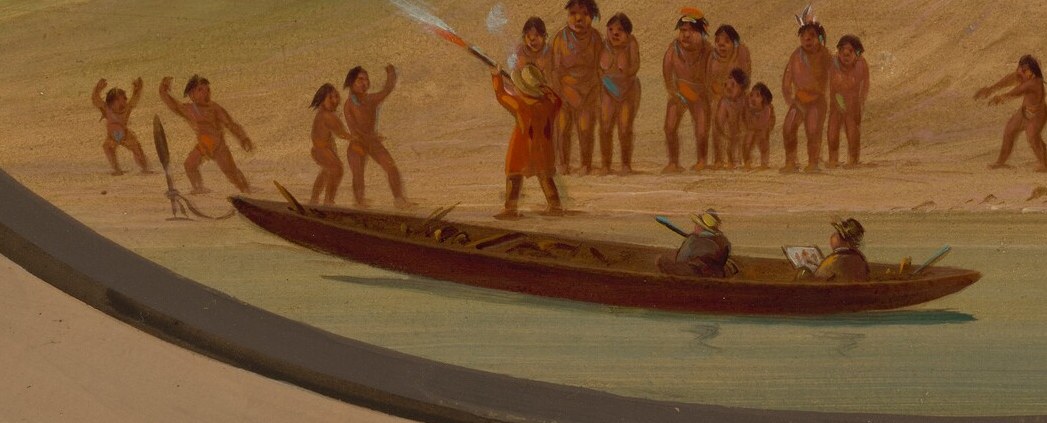
This is George Catlin's 'A Small Lengua Village' from 1862, a quiet record of a Lengua community in South America. It lives far from his famous Plains Indian portraits, made late in a career spent racing to document Indigenous life before it was irrevocably changed.
Look first at the lower left corner. You will see a small mark in red paint, the artist's signature, but also a number: 'A 444.' This is not a date or a secret code. It is a catalog number from Catlin's own system of inventorying his work. He was not just a painter; he was trying to build an archive that could be sold, piece by piece, to support his travels.
Catlin began as a lawyer but left the profession behind after seeing a delegation of Native American leaders in Philadelphia. He spent decades on the frontier, eventually producing over 500 paintings. By 1862, when he painted this Lengua settlement, the United States was consumed by the Civil War. Catlin was still out on the edges, turning quiet, everyday scenes into a systematic record.
That small red 'A 444' is the whole story in one detail: a human encounter reduced to a line in a catalog, made by a man who understood that the only way to save what he saw was to turn it into a commodity. What do you think that number meant to him?
Details
Transcript
A simple village. Thatched huts, palm trees, a quiet river. George Catlin was a lawyer who left the courtroom to paint Native American life. By 1862, he had been documenting Indigenous communities for over thirty years. But look at the lower left corner. A small mark in red paint. Not just a signature. A number: A 444. This was a working inventory code. Catlin turned his paintings into a catalog for sale. A record of a people, numbered like a ledger entry.