Off Greenland—Whaler Seeking Open Water by William Bradford
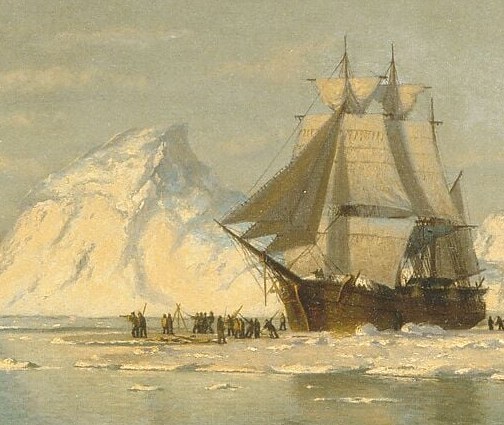
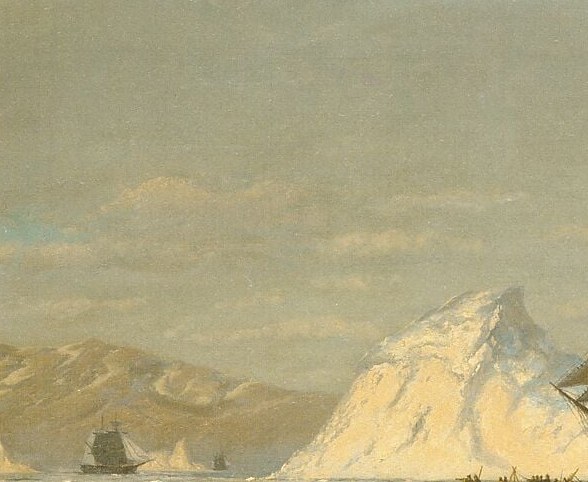
This is William Bradford's "Off Greenland, Whaler Seeking Open Water," painted in 1857 and part of his early career before he became famous for leading Arctic expeditions himself. The painting is a hybrid: part ship portrait, part romantic landscape. Bradford grew up in Fairhaven, Massachusetts, across the river from the New Bedford whaling fleet. His first paying work was painting the portraits of individual ships for their captains, and this canvas carries that discipline into a vast and indifferent wilderness.
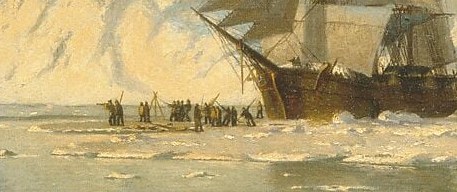
Look at the dark hull of the brig sitting low against that cathedral wall of ice. Every stay, shroud, and yard on the rigging is delineated with a ship portraitist's precision. Then look left, and you will find a small open boat already in the water. That is the whaleboat, the fragile craft that would actually approach the whale with a hand-thrown harpoon. Its presence changes the painting from a seascape into a moment of active, high-stakes labor.
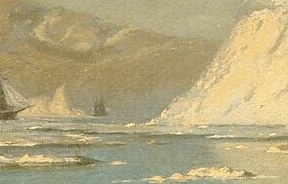
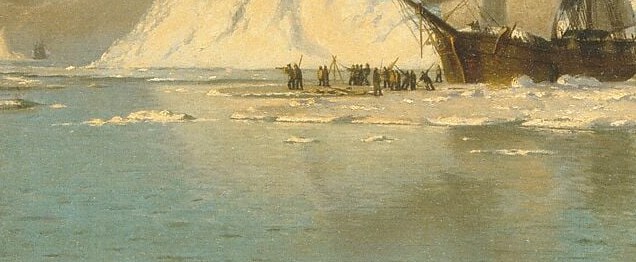
A single successful Greenland voyage could bring back whale oil worth today's equivalent of a small fortune. The payoff was enormous, but so was the risk. Ships were routinely crushed by shifting pack ice. Bradford never quite leaves the danger behind: the water in the foreground is littered with broken floes, and the open lead the ship steams toward is a dark, reflective ribbon that could close as quickly as it appeared.
You are looking at a moment when one captain's balance sheet hangs between a fortune in oil and the weight of all that ice.
Details
Transcript
A whaling ship. Alone. Seeking open water. The painter was a New Bedford ship portraitist. His clients were captains. Men who lived and died by these hulls. Look to the left. A small boat. That is the whaleboat. Where the actual hunt happens. Off Greenland, a single voyage could bring back oil worth a fortune. Or you could be crushed in silence. The glassy water knows.