King Solomon and the Queen of Sheba by Master of Lecceto
This is "King Solomon and the Queen of Sheba," painted around 1500 by an artist now known only as the Master of Lecceto. It hangs today at The Metropolitan Museum of Art, but its path there was strange and unlikely.
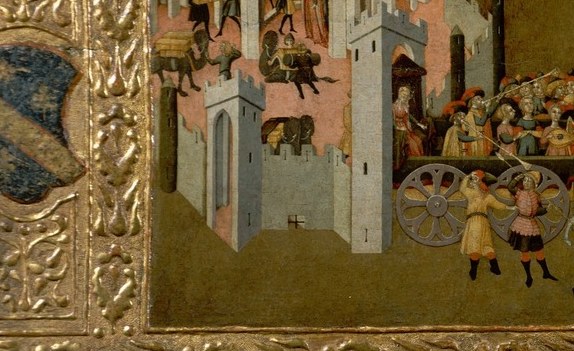
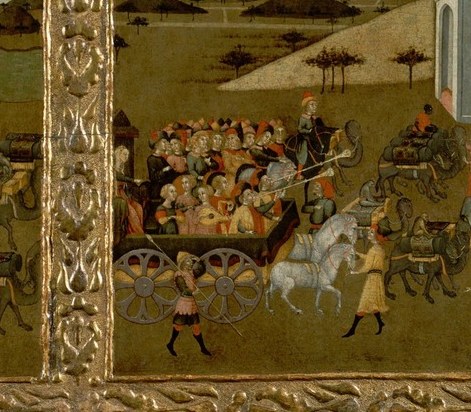
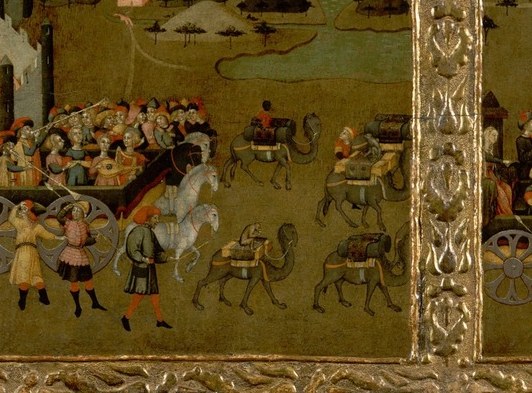
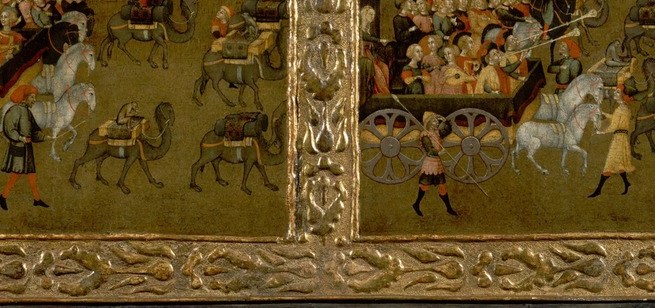
The painting shows the biblical encounter as a grande pageant: the Queen approaches from the left with a retinue and cargo wagon, while Solomon's court fills the right side. Look for the pale horse at center-left, a signal of the Queen's wealth, and the background towers that likely represent Solomon's temple in Jerusalem. The gold-leaf frame is original, likely part of a larger altarpiece.
Around 1860, a British consul named John Temple Leader found the painting in the bathroom of a villa he was buying outside Florence. It was dark with soot and likely used as a wall panel. The villa had belonged to the Strozzi family, and the painting had probably been concealed there, its value forgotten, for a hundred years or more, through Napoleonic looting and political upheaval that destroyed countless Renaissance works.
Hidden from conquerors, ignored by inheritors, a bathroom panel became a museum treasure. What do you think the person who hid it would feel, knowing it survived?
Details
Transcript
Florence, 1860. A British consul is house-hunting. In a villa bathroom, he finds this: a gilded panel, dark with grime. The Queen of Sheba arrives. Her pale horse signals elite status. King Solomon welcomes her. A moment of diplomatic theater. Concealed for perhaps a century, it survived wars and neglect. He bought it for a small sum and carried it to London. Today, the Master of Lecceto's work rests safely in New York.