Leatherstocking's Rescue by John Quidor
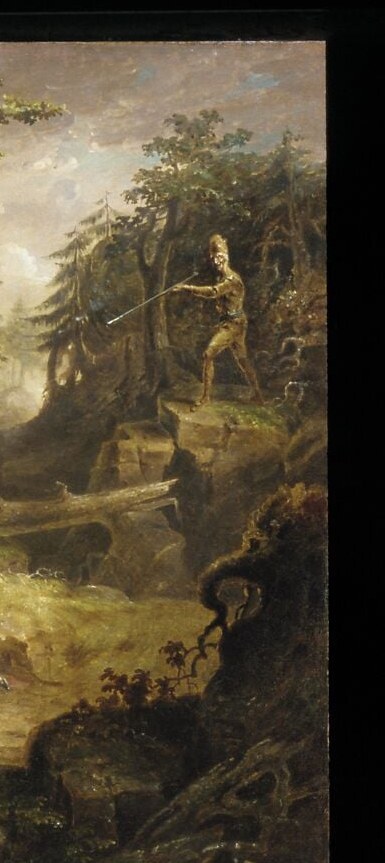
This is John Quidor's "Leatherstocking's Rescue," painted in 1832. It hangs today at the Smithsonian American Art Museum. Quidor made only about 35 surviving paintings, most drawn from the stories of Washington Irving, but this one takes its drama from James Fenimore Cooper's Leatherstocking Tales. The painting is a code: every object carries a meaning that a viewer in 1832 would have read immediately.
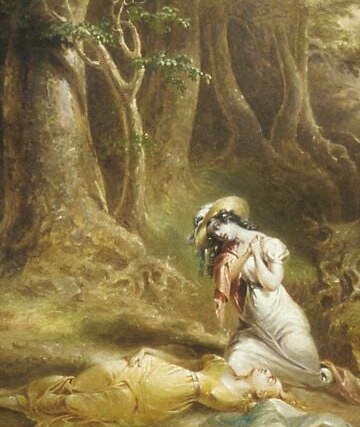
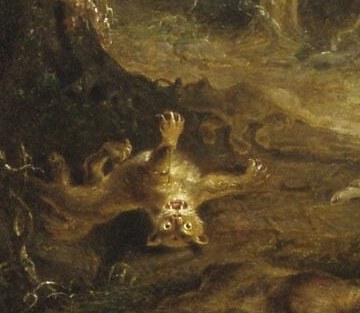
Look at the central woman in white. Quidor makes her dress a beacon against the dark forest. In the visual language of the time, that luminous white stood for innocence under threat. The bear, low and dark in the foreground, was the untamed continent itself, the danger that justified the frontiersman's existence. Then look at Natty Bumppo on horseback. Quidor keeps him in shadow. He is a rescuer, but an ambiguous one, heroism that feels uncertain rather than triumphant.
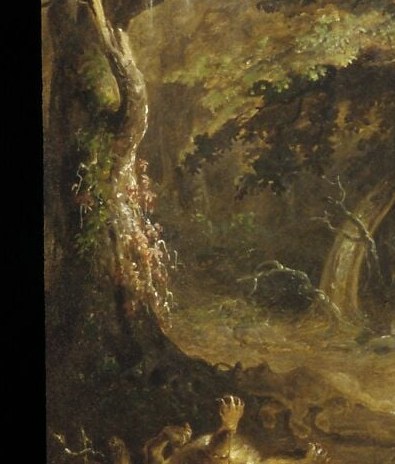
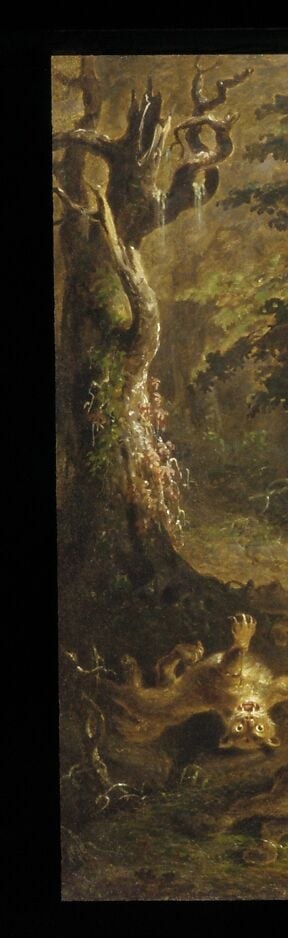
Quidor painted this at the height of Cooper's popularity, when Americans were still working out what the frontier meant. The forest itself is a character: the gnarled tree on the left and the dense mass on the right lock the scene in. There is no way out except through the drama unfolding in the middle. Quidor was not interested in realism. He wanted theater, theatrical lighting, exaggerated postures, a story pushed to the edge.
Only a few dozen Quidor paintings survive. For decades he was nearly forgotten, rediscovered only in the twentieth century. This canvas is one of the reasons his reputation returned: a frontier myth painted as an uncertain gamble.
Details
Transcript
It looks like a rescue in the wilderness. Quidor paints her dress as a beacon of white. In the code of the time, that blinding white meant innocence under threat. The bear is the engine of the scene, low and dark. For early Americans, the bear was the untamed continent itself. A rescuer charges from the left. But Quidor keeps him in shadow. Heroism here is real but uncertain. Not a triumph, a gamble. The trees lock the edges. There is no escape from this history.