View of Marshfield by Heade, Martin Johnson
View the artwork: View of Marshfield →
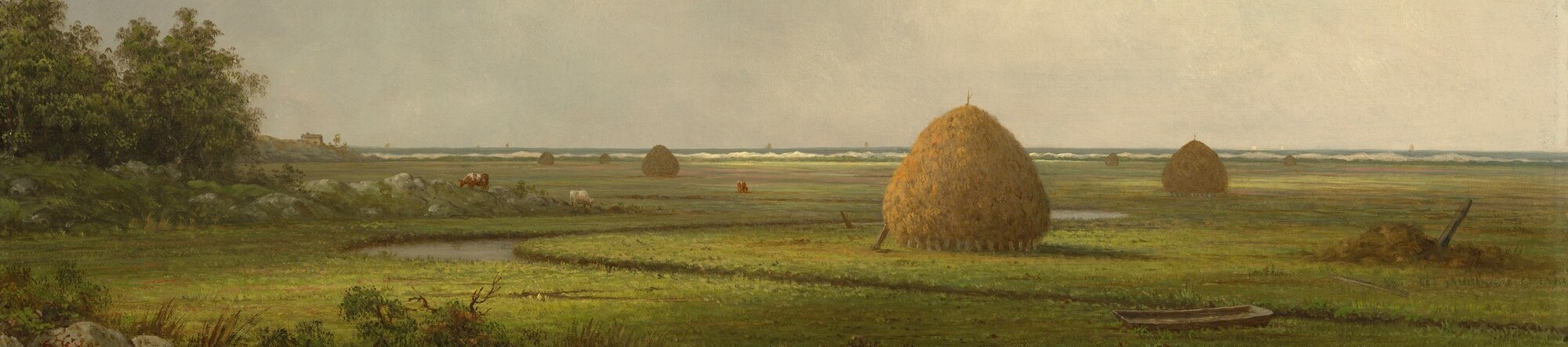
Martin Johnson Heade's "View of Marshfield," painted around 1866, is a quietly radical painting hiding in plain sight. It belongs to a small, strange movement called Luminism, a distinctly American approach to light that His real subject wasn't the marsh itself, it was the way light surrenders solid form to atmosphere.
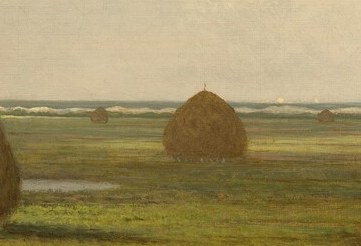
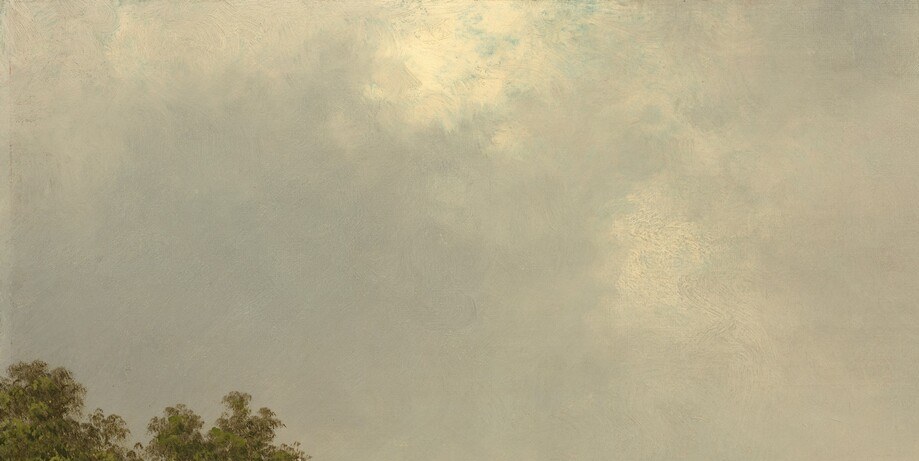
Start with the glowing cloud mass in the upper center of the sky. Heade paints it lit from within, no visible sun, just diffuse interior radiance. Then trace that same light downward. It reappears in the tidal creek snaking through the marsh, a classic Heade device for visually stitching sky to earth. The two large haystacks anchor the composition, but there is a third one, barely visible, at the left edge of the marsh. It has nearly dissolved into the humid salt air, and that near-dissolution is the whole point of the painting.
Heade spent decades painting salt marshes from Newburyport, Massachusetts, to Florida. He was an outlier, friends with the Hudson River School painters but never quite of them. His canvases are radically horizontal, almost abstract in their flatness, and his weather is meteorologically precise. Those cumulus clouds on the left are built on a real inversion layer. The dark cloud mass pressing in from the right suggests a storm arriving or departing, lending the stillness a suppressed tension most viewers sense before they understand why.
"View of Marshfield" is in the collection of the Smithsonian American Art Museum. Next time you stand before a Luminist painting, look for what's almost gone. That's where the real work is happening.
#arthistory #americanart #luminism
Details


Transcript
The light in a Heade marsh is never an accident. Start with what glows: a cloud lit from within. Now find where that light lands on the earth. He slips it into the tidal creek, sky pulled down into the marsh. Two haystacks anchor the field. But Heade planted a third. At the left edge of the marsh, nearly dissolved into the haze. He was a Luminist. Their subject was light dissolving form.