Peace and Plenty by George Inness
George Inness painted 'Peace and Plenty' in 1865, the year the American Civil War ended. It hangs today at The Metropolitan Museum of Art, an answer to a country that had just buried 600,000 of its own. The title names what the painting does: it pictures a nation trying to believe in abundance again.
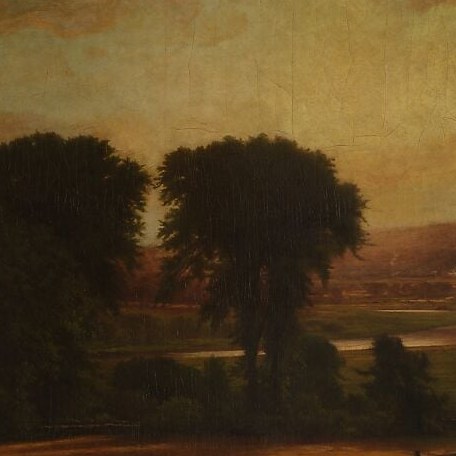
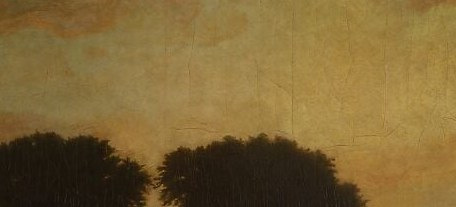
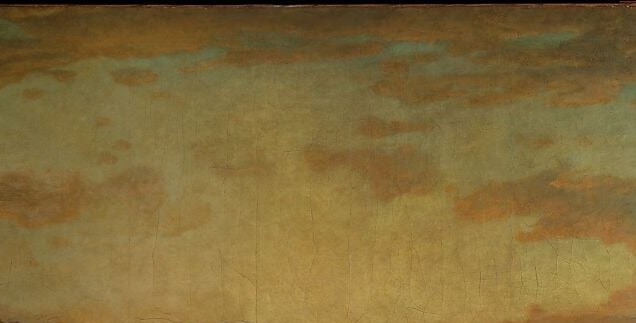
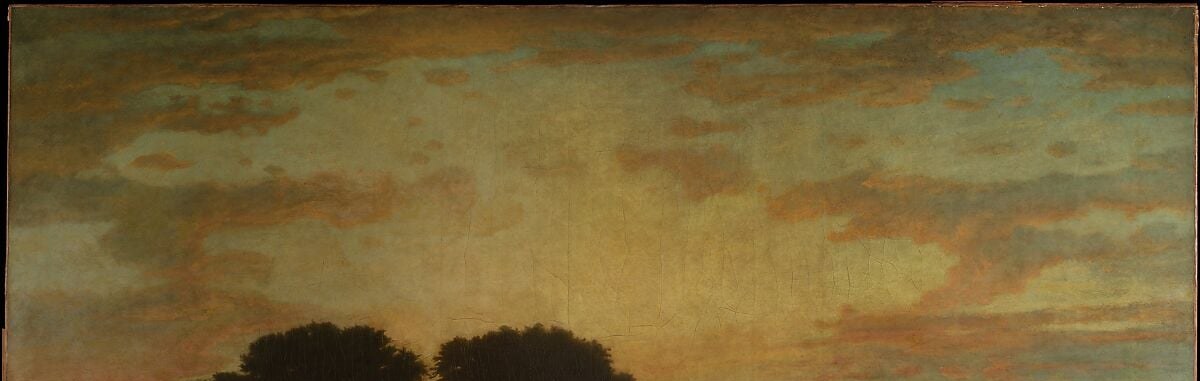
The thing to watch is where solid earth meets air. Inness refused to draw a hard line between the treetops and the sunset sky. He dragged a dry brush through wet paint, ochres bleeding into warm grays, so the canopy dissolves into light. The clouds are even looser: dragged pink and gold strokes that feel like they're still moving. This is not a landscape you look at; it's a landscape that looks back at you breathing.
Inness had studied the Hudson River School, then the Barbizon painters in France, and somewhere in between he found the theology of Emanuel Swedenborg, who believed the physical world was a living correspondence to the spiritual one. By the end of his life Inness would paint over a thousand canvases, each one an argument that a tree was never just a tree. Here, the dark foreground soil is the most tactile thing in the picture, dirt you could dig, and the sky is the most immaterial. The cattle grazing in the middle ground are the bridge: ordinary life, restored.
The storm clouds hanging at the upper left aren't an accident. Peace in this painting isn't a starting point; it's something that outlasted trouble. The gold at the horizon was earned.
Details

Transcript
A farm at dusk, 1865. The Civil War had just ended. The dark trees still carry the weight of what happened. But look at the sky above them. The treetops don't end. They blur into gold. Inness dragged wet paint across wet paint, no hard edge, no boundary. Now the clouds. Loose, pulled strokes, pink and gold. The paint isn't describing clouds. It's describing light breathing. He called paintings like this 'a higher reality', earth dissolving into spirit.