Tea Party by William P. Chappel
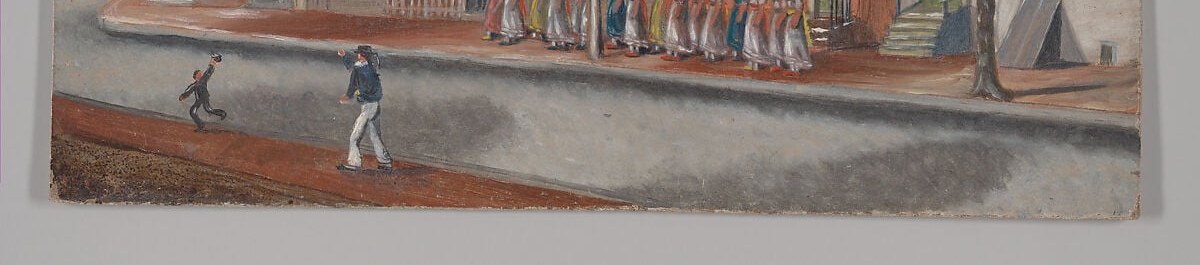
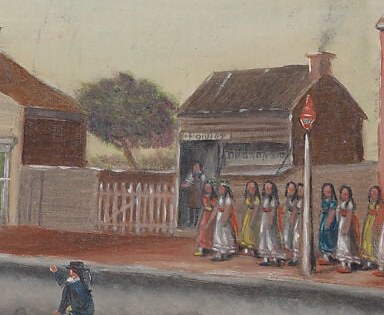
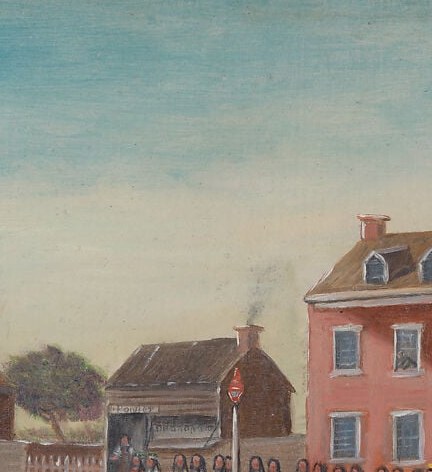
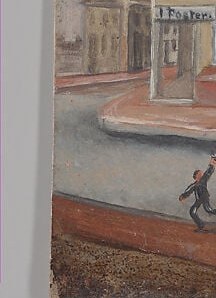
This is William P. Chappel's "Tea Party," painted in the 1870s on a sheet of slate paper. The painting records an ordinary afternoon on an American residential street, likely in New York, where Chappel lived and worked his whole life. A cluster of women in bonnets gather beyond a white picket fence while a lone figure approaches from the left, giving the whole scene an unhurried narrative pull.
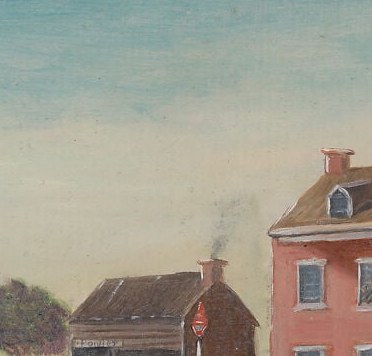
Look at the surface. Chappel painted on slate paper rather than canvas, a support so smooth and non-absorbent that it allowed him to keep fine details exceptionally sharp. The even windows of the pink central house, the clarity of the fence rails, and the pale gradation of the sky all benefit from that choice. The reddish dirt road at the bottom anchors the composition and dates the scene before widespread paving.
Chappel was born in 1801 and died in 1880. His small body of surviving work consists largely of precise, unsentimental views of everyday New York streetscapes and waterfronts, made during the same decades the city was transforming into a modern metropolis. Paintings like this one function as visual records of a lost vernacular America: the architecture, the fences, the unpaved roads, the rituals of middle-class social life played out in front yards.
It is not a grand canvas. It was never meant to be. But it preserves a block of American time with an almost archaeological clarity.
Details
Transcript
Meet me on this street corner, around 1875. The road is reddish-brown dirt. No pavement yet. Beyond the white picket fence, a tea party is starting. This whole scene was painted on a sheet of slate paper. Slate is smooth and won't absorb. Every window stays crisp. One man walks in from the left. The gathering pulls him home.