House Raising by William P. Chappel
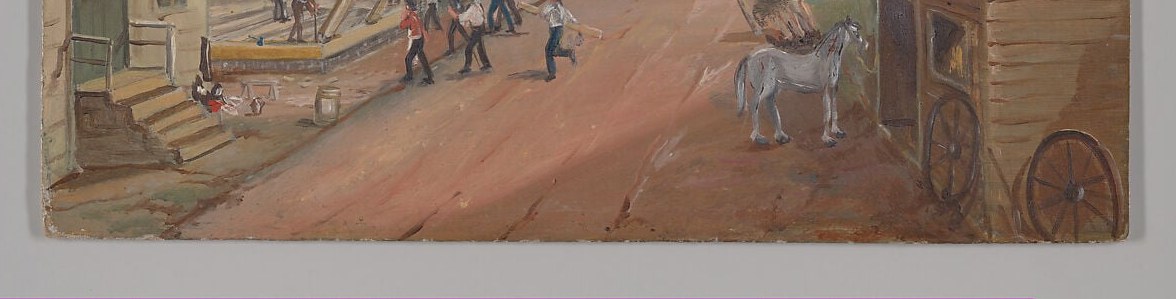
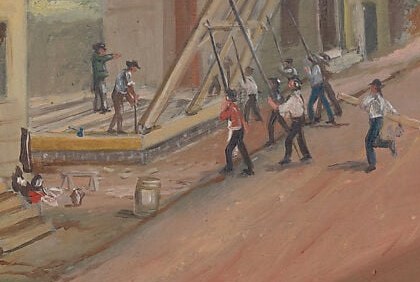
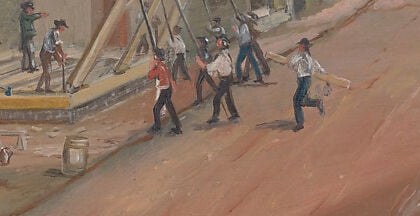
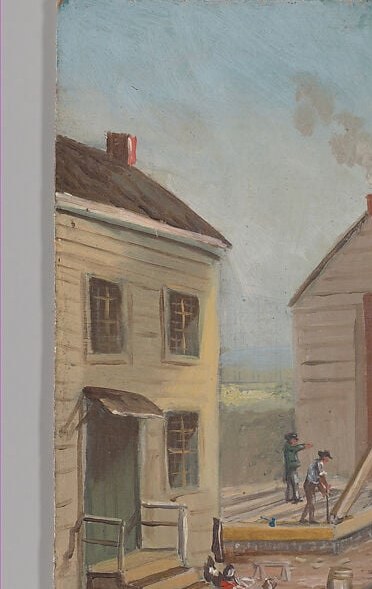
William P. Chappel’s 'House Raising,' painted in the 1870s, captures a neighborhood literally building itself by hand. In an era before mechanical cranes, the wooden frame of a new home goes up through sheer communal muscle. Ropes, raw timber, and coordinated neighbors replace the machinery we take for granted today.
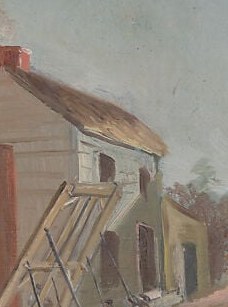
Look at the unpaved ochre street in the foreground. It's a powerful timestamp: no cobblestones yet, the city's surface still as provisional as the house frame rising above it. Notice the lone worker perched high on the bare beams against the open sky, working without a harness. And study the finished brick building to the left. It shows exactly what this skeletal frame will become.
Chappel chose an unusual medium for this scene: oil on slate paper. The thin stone support gives the painting its distinctive soft, slightly chalky luminescence. This atmospheric quality makes the record of hard physical labor feel almost tender. The artist himself lived from 1801 to 1880, witnessing New York transform, and here he documents the very mechanism of that change.
Every building on this block started as a moment like this: a community ritual, a human chain, a shared risk. When you look at the horse standing patiently beside the urgent hauling, you get a quiet friction between animal calm and the sheer human will to build a city.
Details
Transcript
New York, the 1870s. No cranes, no power tools. This raw dirt street is a city block still becoming itself. A wooden skeleton. Men hauling on ropes do the work of engines. One man rides the bare timbers. No harness. No net. The stone foundation is the exact moment earth becomes home. And the finished house next door is the promise of what this frame will be. Chappel painted this on slate paper, giving the whole scene its soft, chalky light.