Untitled by Chen Chun
Chen Chun painted this untitled handscroll in 1513, and it now lives in the collection of the National Palace Museum, Taipei. It is a landscape built as much from blank paper as from ink, a river and mountains rendered in the shorthand of the literati, where what is left unpainted carries as much meaning as the marks themselves.
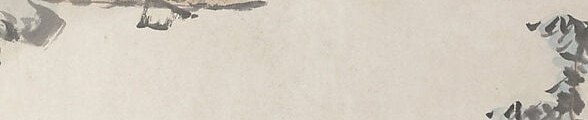
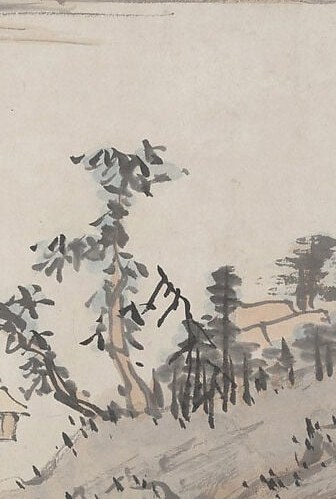
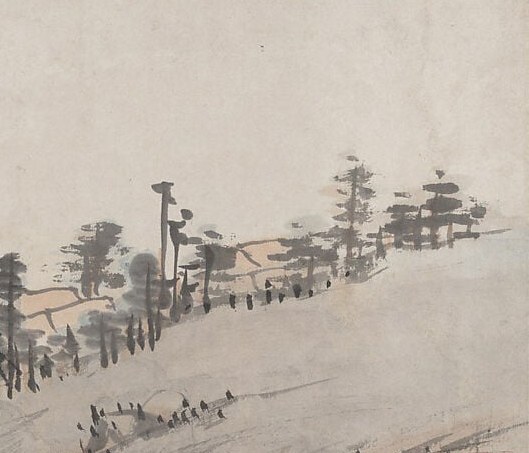
Look first at the wide, pale channel running through the center. That is the river, defined only by its banks, its surface one long breath of bare paper. Now find the dark cluster of pines on the rocky promontory, the most vertical accent in the whole scroll. In the scholar-painting tradition, the evergreen pine is the gentleman who refuses to bend to political winds. Below it, a handful of brushstrokes form a single small boat, easy to miss at left. That boat does not hurry. It drifts.
Chen Chun was born in 1483 into a wealthy Suzhou family and studied under the great Wen Zhengming. He absorbed the literati ideal completely: painting was not a trade but a practice, a conversation between educated friends. This scroll was likely made for a colleague who had left official life, the retired scholar-official who withdrew to the countryside to read, write, and cultivate virtue far from the corruption of the court. Every element in the scroll encodes that choice.
A handscroll is a private medium. You unroll it one arm's length at a time, traveling through the space alone. This one does not shout. It waits, quiet and upright, like the man it was made for.
Details
Transcript
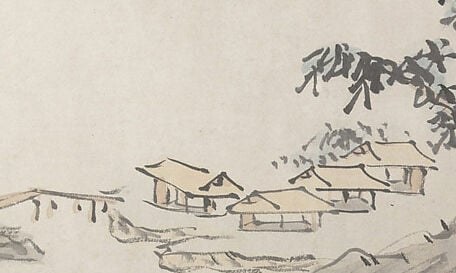
A river vanishes into mist. The blank paper is the water. The emptiness is the point. Evergreen pines on a rocky height. The scholar who will not bend. A tiny boat at the margin. A life withdrawn from the world of men. Houses nestled into the hillside. The recluse who chose simplicity. Chen Chun painted this for a friend who had retired from office. Every stroke honors that choice.