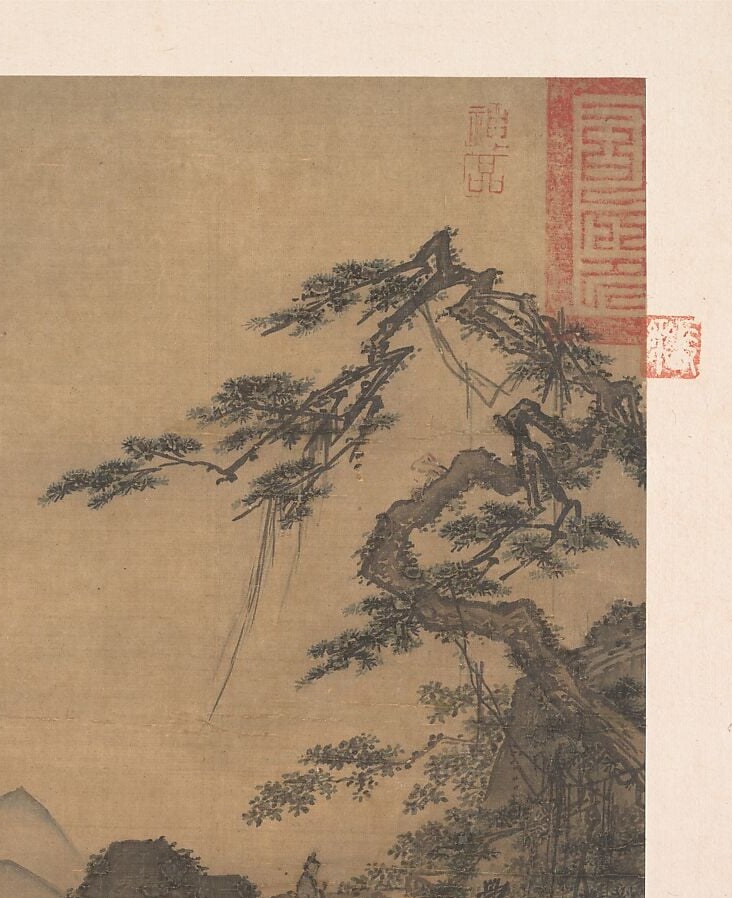
南宋 馬麟 松下高士圖 冊頁 絹本|Landscape with great pine by Ma Lin
The album leaf that hides a distant world.
This is "Landscape with Great Pine" by Ma Lin, a Southern Song dynasty court painter who completed this small ink-and-color work on silk in 1238. It now lives in an institutional collection, a quiet masterwork of the intimate album-leaf format. Court painters of the period created these works not for public halls but for private contemplation, and Ma Lin built a secret into his composition.
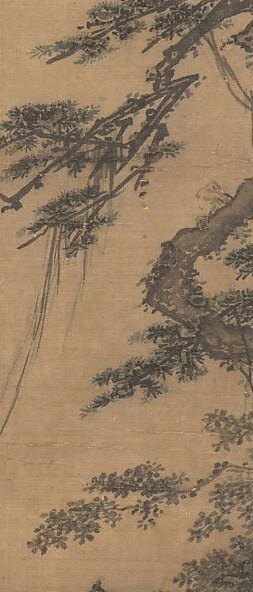
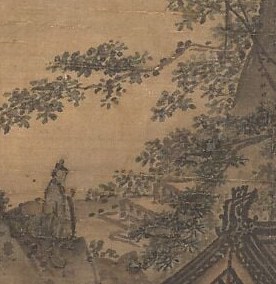
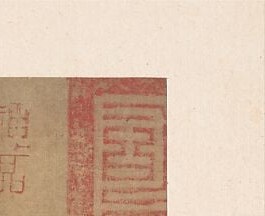
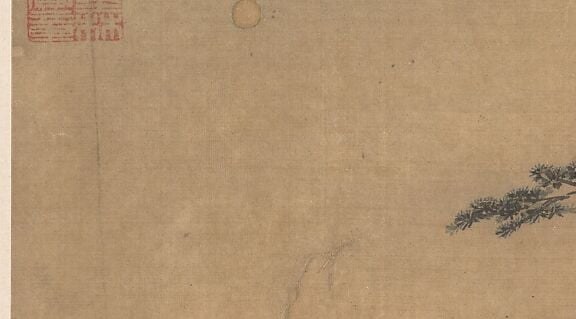
Start with the pine, the painting's undeniable anchor. The serpentine trunk dominates the frame, its bark textured with virtuoso "broken brush" strokes that survive close inspection today. Beneath it, a tiny scholar sits on a rocky outcrop. The scale is the meaning: nature dwarfs all human presence. But the real hunt is in the margins. Look to the upper right corner and find the red collector seals, the forensic stamps of successive imperial courts. Then let your eye drift past them, into the mist, until a line of pale ink resolves into a distant mountain ridge. It is almost not there.
Ma Lin was the son of the great Ma Yuan and inherited his father's command of atmospheric ink wash. The far ridge is a demonstration of pure confidence: hiding the third spatial plane of the painting in plain, near-invisible sight. In Chinese landscape theory, this void is as much a subject as the pine. The empty mist carries the weight of infinite space, and the ridge is a reward for those who slow down enough to look.
What other details survive in eight centuries of silk and ink that no photograph can fully transmit?
Details
Transcript
This great pine has stood at the heart of Chinese painting for nearly 800 years. Look at the masterful brushwork in the twisting trunk. Beneath it, a solitary scholar. The painter made him deliberately small. Now look to the margins. These red seals are the stamps of emperors. And above them, a ghost. A mountain ridge painted in the palest ink. Ma Lin knew you would only find it if you leaned in.