Sunset on the Sea by John Frederick Kensett
John Frederick Kensett painted *Sunset on the Sea* in 1872, months before his death in December of that year. It hangs today in the Metropolitan Museum of Art, an institution he helped found.
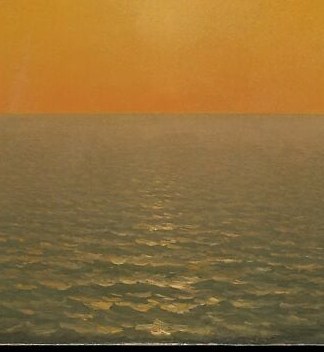
What you are looking at is not a bravura sunset but a Luminist one. The sun has no hard rim. The corona glows outward in soft, graduated bands of peach and gold, and a single vertical lane of reflected light runs down the center of the water. Two tiny ships near the horizon are nearly dissolved by haze. The painting is built on stillness, a ruled-flat horizon, dark water at the margins funneling your eye to the light, and almost no brushwork that calls attention to itself.
Kensett was a second-generation Hudson River School painter who moved away from the drama of his teacher Thomas Cole. He preferred spare geometry and glassy water, and the works of his final years are the purest expression of that restraint. This canvas sat in private collections for over a century. In 1978 Sotheby's auctioned it, where a telephone bidder won it for $95,000, the top price for any American painting sold anywhere that season.
A founder of the Met, painting a quiet ocean at the end of his life. The museum now owns the work he made that year. The price record is a footnote. The painting itself hasn't moved.
Details


Transcript
John Frederick Kensett painted this in 1872. It was his final year. He was a founder of the Metropolitan Museum of Art. He died that December. The sun rests just above the water, dissolving without a hard edge. A narrow lane of gold comes straight down the center of the sea. Two small ships near the horizon. The only trace of the human world. It stayed in private hands until 1978. Then Sotheby's put it on the block. A telephone bidder took it for $95,000, the highest price of any American painting that season.