Saint Agapitus of Praeneste in the Arena; (interior) The Beheading of Saint Agapitus of Praeneste by http://www.wikidata.org/.well-known/genid/e5a6c60f0e0fcc71d288d54b4ec96758
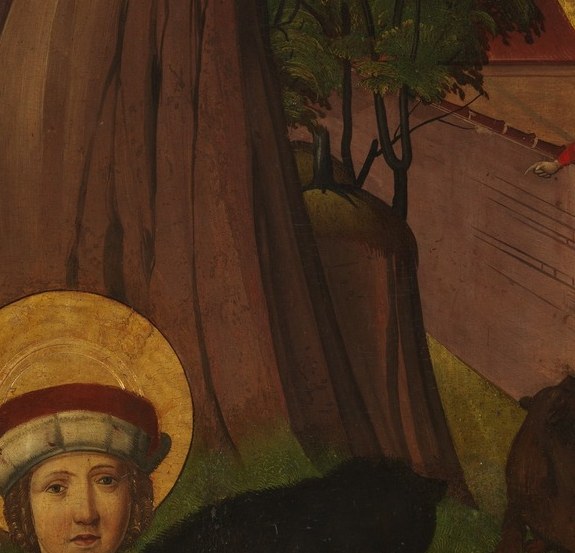
This is Saint Agapitus of Praeneste in the Arena, painted around 1500 by the anonymous Master of the Saint Bartholomew Altarpiece. It hangs today in a format most visitors never fully see, because this serene exterior is only half the story. The panel has an interior: a hinged wing that opens to reveal the beheading itself, kept literally out of sight until someone chooses to look.
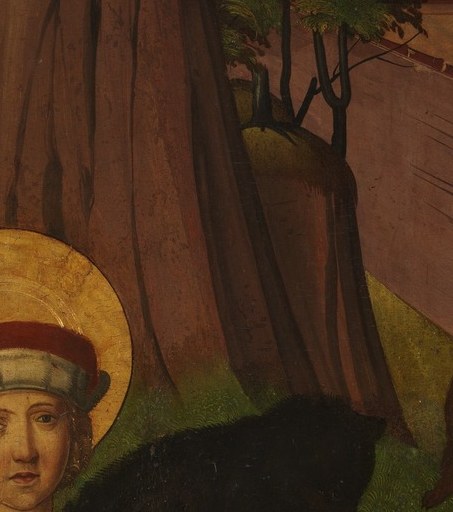
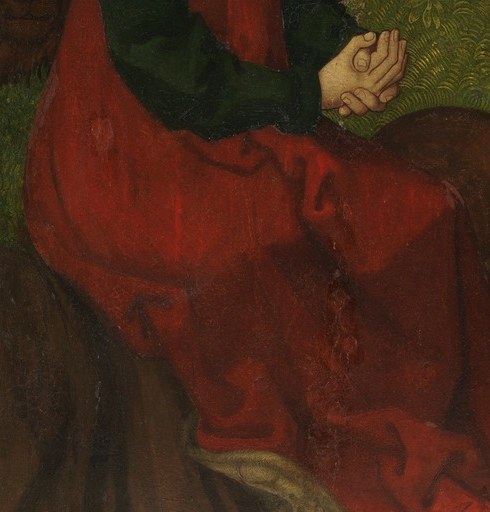
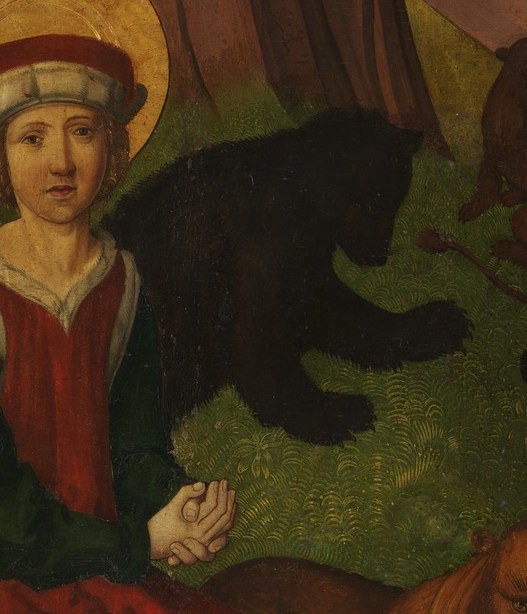
The exterior shows the miracle that made Agapitus a saint. The tawny lion at her feet was meant to kill her in the Roman arena. It refused. Its lowered head and docile posture are the whole theological argument of the painting: sanctity subdues violence. The red robe she wears is the liturgical color of martyrdom, the fate announced even in a scene of calm.
Agapitus was a fifteen-year-old Christian executed at Praeneste (modern Palestrina, Italy) under Emperor Aurelian around AD 274. Tradition says he survived the lions and was beheaded instead. This altarpiece, produced in Cologne for a German-speaking church, splits that narrative across two painted surfaces, the public miracle and the private execution, a format common in late-medieval northern altarpieces.
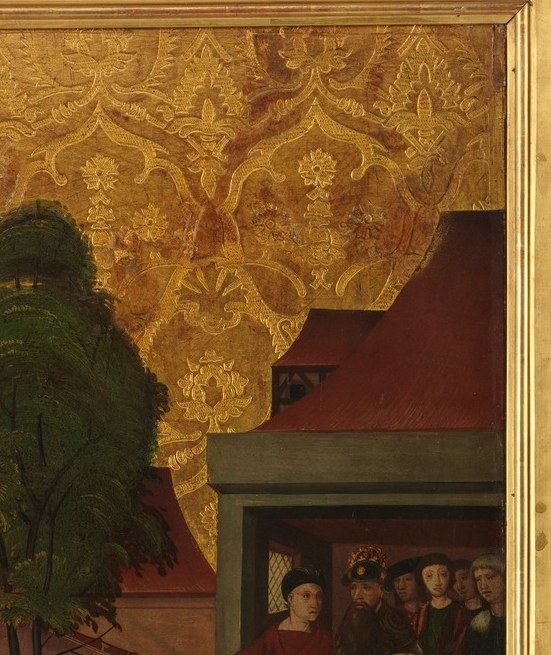
The gold-leaf background places this panel right at the cusp around 1500, when flat gilded heavens were yielding to naturalistic landscapes. That tension, eternal gold versus earthly arena, is the visual signature of its moment.
Details
Transcript
She looks untroubled. Almost bored. The title says she was thrown to lions and beheaded. This lion refused to attack. A miracle made visible. The red robe signals the martyrdom that awaits. That crowd in the back is inside the Roman arena. And this painting has a second half, behind a closed panel. Inside: the beheading itself, kept hidden until you open it.