Ramesses III and Prince Amenherkhepeshef before Hathor by Nina M. Davies
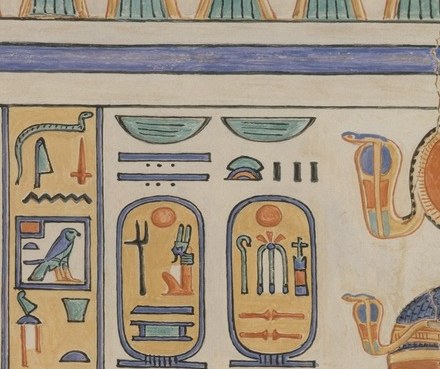
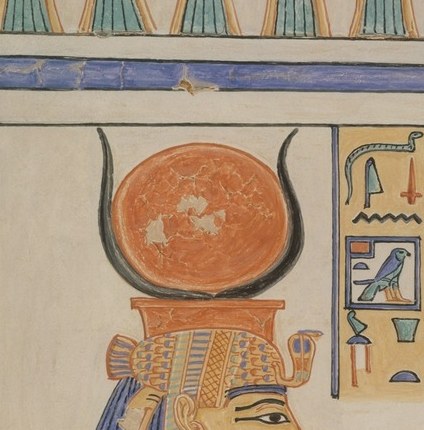
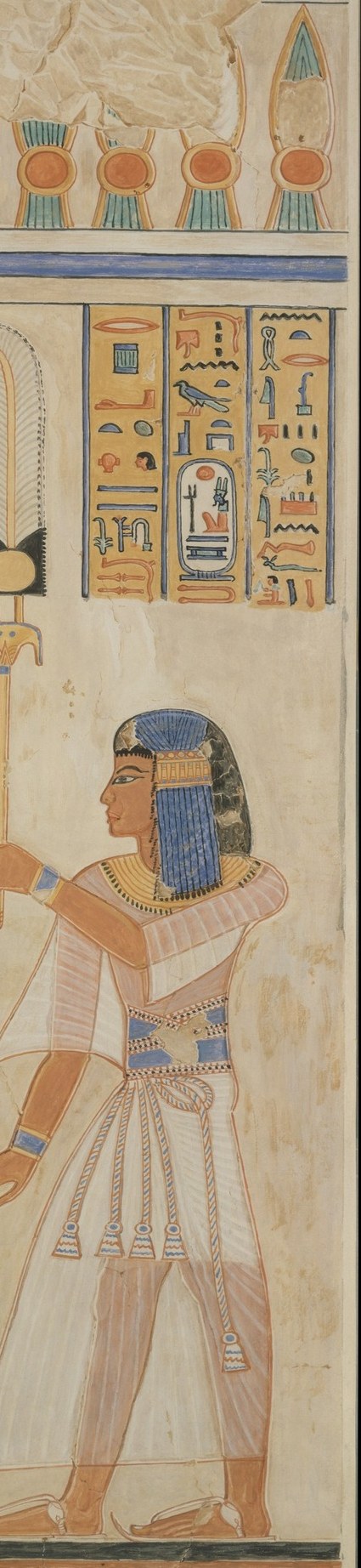
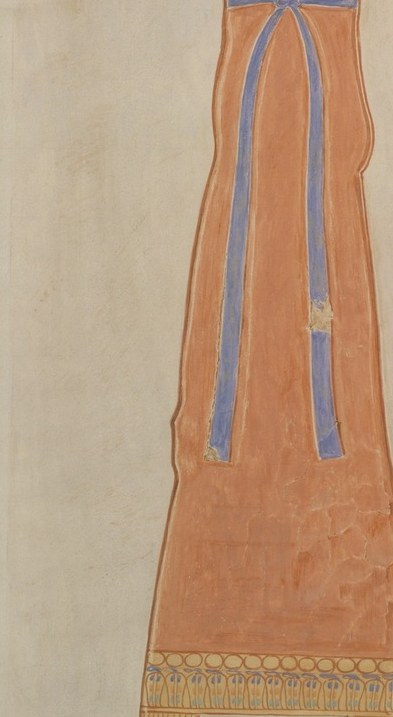
This is a painted copy. Not an ancient Egyptian wall painting, but a 1931 reproduction made by British Egyptologist Nina M. Davies. It depicts Ramesses III and his son Prince Amenherkhepeshef standing before the goddess Hathor, and it hangs in The Metropolitan Museum of Art.
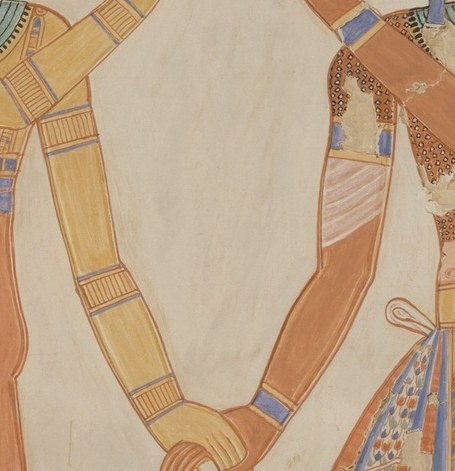
Look at the clasped hands where Hathor meets Ramesses III. The tight linework and the precise, flat rendering of the pharaoh's faience collar are not the work of an ancient artisan. They are Davies's own, executed with watercolor on paper while she sat inside a dim, crumbling tomb. Every hieroglyph in the right column was traced by her hand, not carved by a scribe.
Nina M. Davies and her husband Norman de Garis Davies dedicated their careers in early 20th-century Egypt to a singular mission: recording wall paintings that were actively disintegrating. Their joint publications are often signed 'N. de Garis Davies,' obscuring Nina's individual brush. But her reproductions, painstakingly accurate, now serve as primary sources for scholars because the originals on the tomb walls have faded further or been lost entirely.
There is a particular, quiet triumph in this. Ramesses III wanted eternity; his artists gave him stone. But it was a woman with a brush in a crumbling chamber, three millennia later, who actually secured it.
Details
Transcript
She was not a tomb painter three thousand years ago. She was an Egyptologist in the 1930s, recording what was crumbling. Nina Davies spent her life inside tombs, copying walls before they vanished. This is her hand. Every sharp line, every flat color is hers. She and her husband Norman worked together, but rarely signed who drew what. They gave decades to a single task: saving what the air was eating. The originals are fainter now. Her copies are what scholars study. A quiet Englishwoman, sitting in the dust, making sure a pharaoh endured.