On the Hudson by Thomas Doughty
This is Thomas Doughty's "On the Hudson," painted around 1830-35. It hangs in the American Wing of the Metropolitan Museum of Art. The single most instructive thing inside it is a deliberate temperature shift: Doughty engineers atmospheric perspective in three measured steps, from the dark warm earth at your feet, through a cooling green middle distance, to a hazy blue mountain veil. Before photography, this depth had to be built entirely by hand and eye.
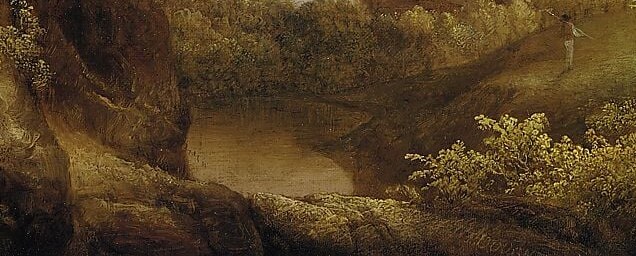
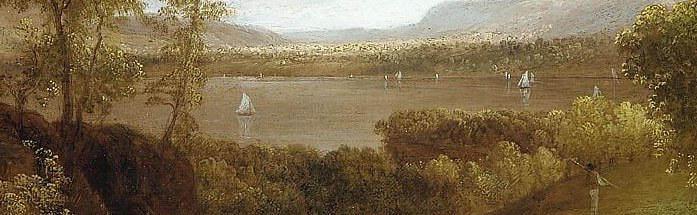
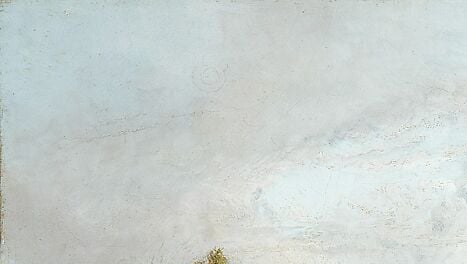
Look first at the deep shadow of the foreground bank. That tonal anchor is the warmest, darkest note in the painting, and it physically pushes the luminous river backward. Next, trace the rolling hills as they cool toward the Hudson's gleam. Finally, watch the far shore dissolve into a pale blue haze. The river itself disappears rather than ending. Doughty lets the water and the sky share a single unresolved glow, pulling you mentally past the painted edge.
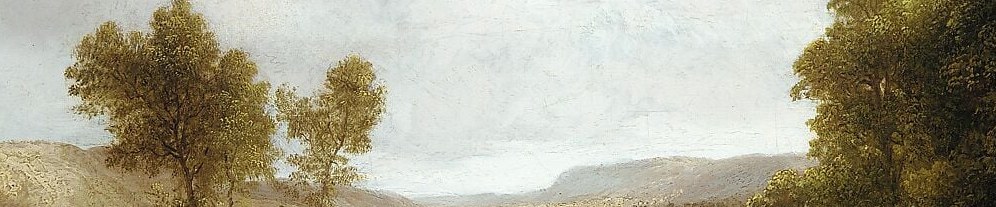
Doughty was a founding figure of the Hudson River School, that early-nineteenth-century movement that treated American wilderness as both fact and symbol. This canvas is a document as much as an artwork: a pre-photographic record of a specific Hudson Valley topography, built from observed leaf masses, gnarled tree trunks, and a real river bend. The left trees frame the scene like a coulisse, a classic device borrowed from European landscape tradition but applied here to native scenery.
A landscape painter's real subject is often the light between things. Here, that light has a structure you can name: warm, cool, cold. The painting is a lesson in how to make air visible.
Details

Transcript
Step one: a warm, dark anchor at your feet. See how the shadow pushes the bright river backward. Step two: the middle distance cools to rolling green. Doughty had no photograph. Every leaf he painted, he placed. Step three: the far shore dissolves into a blue veil. It is a measured trick. Warm, cool, cold. Near, far, infinite.