清 王翬 太行山色圖 卷|The Colors of Mount Taihang by Wang Hui
Wang Hui painted The Colors of Mount Taihang in 1669, at the age of thirty-seven, and the scroll marks the exact moment his career turned. Before this, he was a prodigy of imitation, a young painter who could reproduce any Song or Yuan dynasty master with uncanny precision. Then he traveled north, into the actual Taihang Mountains, and for the first time let direct observation reshape the forms he had inherited.
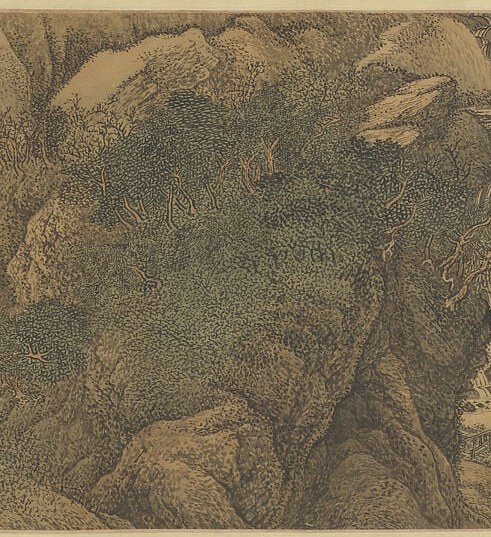
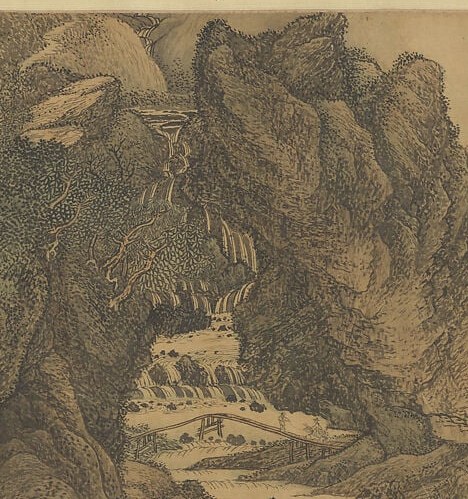
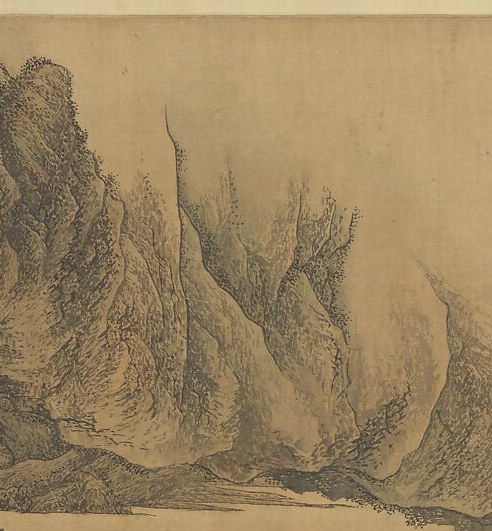
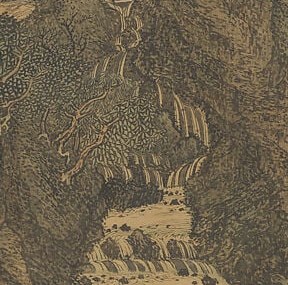
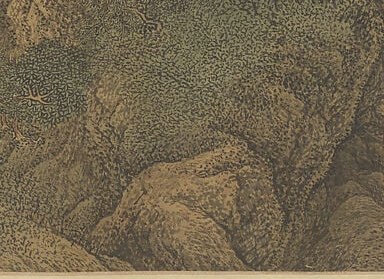
Look at the central gorge. Cool blue-grey washes dissolve into bare silk to create an infinite receding mist, a Song dynasty atmospheric trick Wang Hui revived here from direct experience, not from copying a copy. The waterfall is not painted at all: it is the white of the silk itself, left untouched to become falling water. On the lower left, the boulders carry the most legible brushwork in the scroll, dense accumulations of hemp-fibre and axe-cut ts'un strokes where you can watch the painter's wrist build stone from ink.
The vertical cliff that closes the right edge acts like a stage curtain, and the scattered trees clinging to its face are a scale calibration device disguised as foliage, they tell you just how unliveable this terrain is. The composition was Wang Hui's first serious synthesis of Song structural logic with the feel of a real, observed place, and it set him on a path that would eventually make him the leading painter of the Orthodox School and the artist chosen to record the Kangxi Emperor's southern inspection tours.
The scroll is now held at The Metropolitan Museum of Art as a definitive mid-Qing landscape, a moment when one painter stopped looking at old masters and looked up.
Details
Transcript
Before this, Wang Hui was famous as a copyist. Then, in his thirties, he traveled north. For the first time, he painted what he actually saw. A vertical cliff seals the scroll's right edge like a curtain. Unpainted silk becomes falling water. He built these boulders from hemp-fibre and axe-cut strokes. The farthest peaks dissolve into cool mineral wash. He was thirty-seven. This scroll was the pivot of his whole career.