The Quarry of Monsieur Pascal near Nanterre by Cazin, Jean-Charles
The Quarry of Monsieur Pascal near Nanterre, painted by Jean-Charles Cazin around 1875, is a quiet but clear document of industrial France in the years after the Franco-Prussian War. Cazin recorded a specific site, a quarry owned by a Monsieur Pascal, and turned its dusty, strenuous work into a carefully composed landscape.
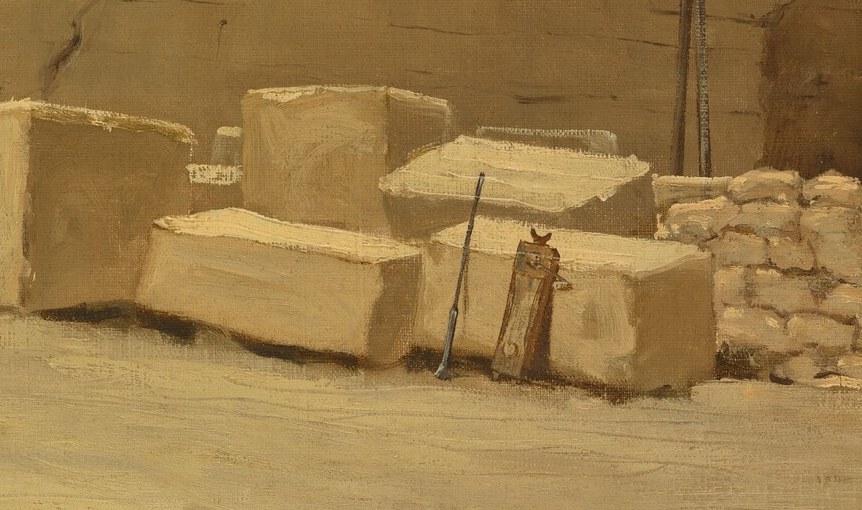
Read the painting like a code. The solitary foreman, standing still in the center, represents capital and oversight. The team of muscular draft horses is the animal power that drove heavy industry before combustion engines. The stacked stone blocks are the literal building material of a modernizing nation. Each element Cazin included is a symbol for a different part of the industrial machine.
Cazin was associated with the realist and Barbizon traditions, artists who left their studios to paint ordinary rural life and labor with serious attention. Here he applied that eye to a quarry, a scar in the landscape where natural resources were extracted, processed, and sold. The dusty atmosphere and muted palette give the vast pit a factual, almost documentary feel.
Next time you see a painting of a peaceful field, remember that just off-camera there was often a place like this, where the stone for the buildings and the roads was being cut out of the earth.
Details
Transcript
A quarry near Paris, around 1875. This man is not a worker. He is the foreman, surveying. His stillness codes for capital: the mind that directs the labor. The muscle is here. Three horses haul the raw stone. Animal power, essential to a nation rebuilding after war. The stone itself. Stacked, measured, a commodity ready for market. All of it, the men and horses, feeding the construction of modern France.