Lake Fucino and the Abruzzi Mountains by Jean-Joseph-Xavier Bidauld
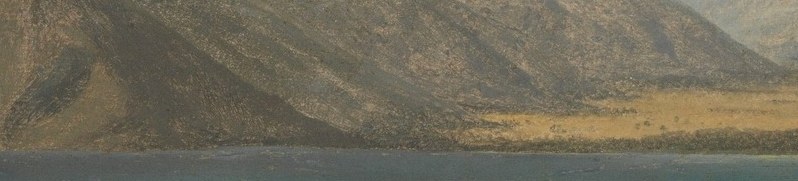
Jean-Joseph-Xavier Bidauld painted *Lake Fucino and the Abruzzi Mountains* in 1795, capturing a geography that no longer exists. The painting shows Lake Fucino, a large body of water in central Italy, framed by the Abruzzi mountains. Eighty years after Bidauld finished this canvas, the lake vanished.
Look at the far shore, where tiny pale forms mark a settlement. Those buildings belonged to the last generation to live beside this water. The ghostly white peaks in the deep distance are the only part of the scene that remains unchanged today. The broad mirror of the lake, the reflections of the mountains, every drop of water you see here is now gone.
Lake Fucino had been a problem for centuries. The Romans tried and failed to drain it. In 1875, a consortium led by a Roman bank finally succeeded, turning the lakebed into farmland. The project erased a landscape that had shaped life in the Abruzzi since antiquity. Bidauld's measured, Neoclassical composition became an accidental historical document, a record of a drowned valley just before it dried.
The painting now hangs in a public collection, its calm surface holding a quiet tension. Every still reflection is a witness to something that was about to be lost.
Details




Transcript
This looks like a timeless Italian view. But the lake you are looking at is gone. Lake Fucino was drained completely in 1875. An ancient Roman project, finally finished by a modern bank. The basin became farmland, erasing a geography that had existed for millennia. Bidauld painted this in 1795, unaware the lake was living on borrowed time. Those tiny pale forms on the far shore: the last villages to see this water. And those ghostly white peaks in the distance are the only part of this view that survived.