Untitled by Seu Family|Manaku
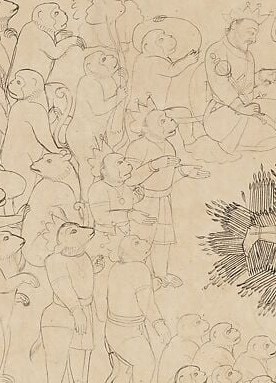
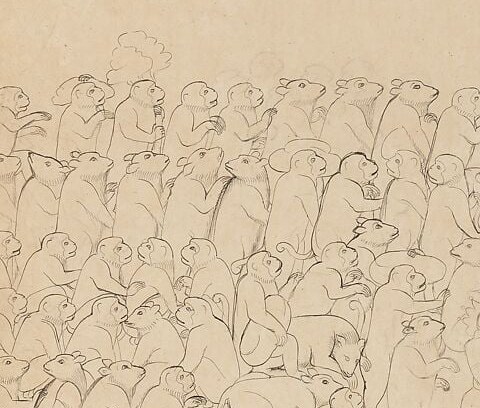
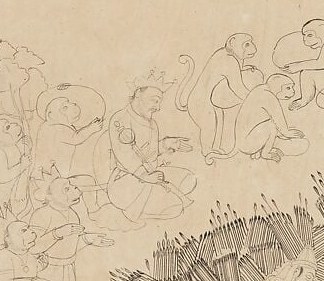
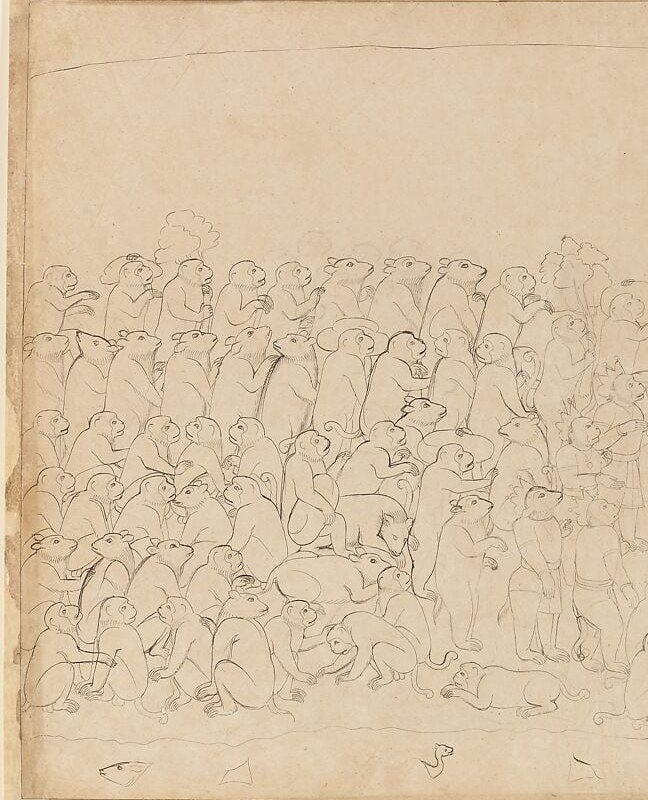
This is Manaku's "Battle of Monkeys and Bears," an ink drawing from around 1725. It shows a moment from the Ramayana, with Rama's monkey army clashing against the bear forces in the forests of Lanka. Manaku was a master of the Guler school in the Punjab Hills, and this sheet is one of the densest, most energetic drawings in Pahari art.
Look at the faces inside the left army. Manaku is working at a near-microscopic scale, yet every monkey warrior gets an individual profile, open mouths, turned heads, distinct expressions. Then look at the arrows: fine diagonal strokes criss-crossing the open sky. They turn a static drawing into a frame of arrested motion.
The thing that makes this drawing feel miraculous isn't just the skill. It's the ink. Manaku mixed his own iron gall ink, the same kind that has destroyed countless European manuscripts by corroding through the paper. Court painters in the hills had to understand the chemistry. If the acidity was wrong, the sheet would have eaten itself within a century. But here it is, three hundred years later, the lines still crisp and the paper intact. The battle scene is a myth, but the survival of the object is a real contest Manaku won.
Details
Transcript
Two armies collide. Every inch of the paper is filled. Monkeys on the left, bears on the right, both firing arrows. Manaku drew this around 1725, in the Punjab Hills. He worked for a court that had lost its power. He kept painting anyway. These faces aren't generic. Every monkey warrior gets a distinct profile. The real survival story is the ink itself. Iron gall ink eats through paper over centuries. If the acidity was even slightly off, this sheet would have crumbled by 1900. But Manaku made his own ink. He knew exactly how to stabilize it.