Merced River, Yosemite Valley by Albert Bierstadt

Albert Bierstadt's 'Merced River, Yosemite Valley' is a 1866 landscape that functioned as a kind of 19th-century cinema. For people on the East Coast, this enormous canvas was their first glimpse of a place they had only heard about in letters and expedition reports.

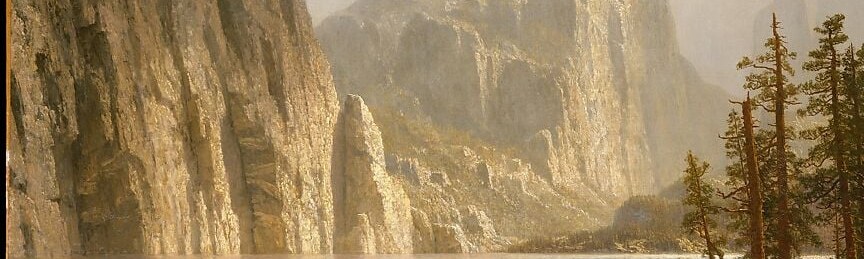
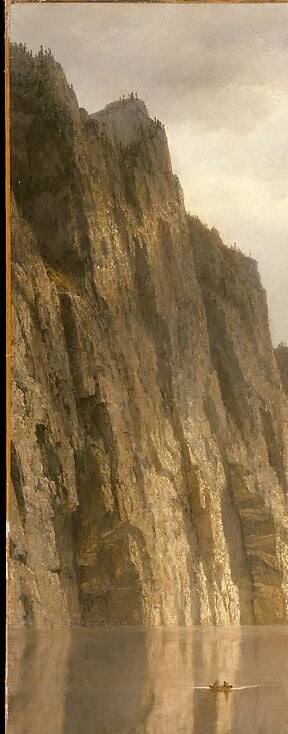
Look at how Bierstadt controls your eye. The Merced River cuts straight down the center, acting as a mirror that doubles the already massive granite cliffs. Then scan the right riverbank until you find the tiny figures. Those are Miwok people, placed there deliberately to make you feel the scale of the place, the cliffs don't just look big, they look impossible.

Bierstadt made this painting in his New York studio from sketches he drew on-site in 1863, during a trip west with journalist Fitz Hugh Ludlow. He was not the first artist to paint Yosemite, but he was the one who made it famous. The canvas entered the Met in 1909 as a gift from the sons of William Paton.

This painting is an artifact of a specific moment in American history: the years when the federal government began seriously discussing protecting these lands. Yosemite was designated a national park in 1890. The argument for preservation was made not just in Congress, but on canvases like this one. What happens to a landscape when millions of people see it and decide it matters?

#arthistory #hudsonriverschool #yosemite

Details
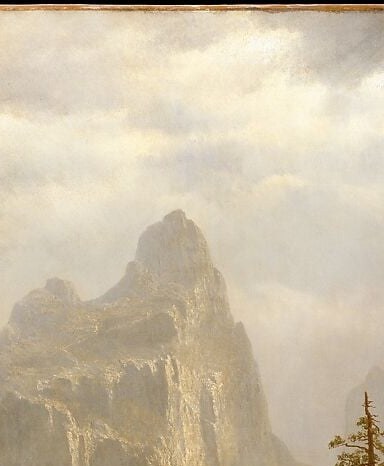
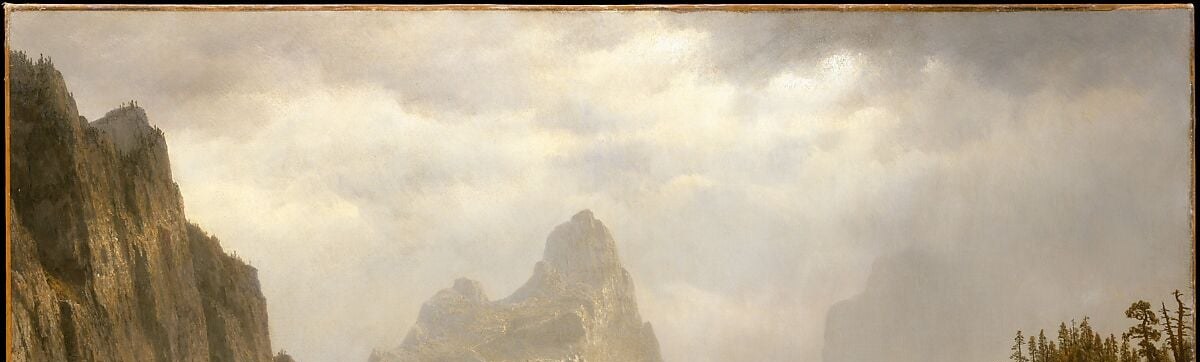
The compositional apex and emotional anchor of the painting , its sheer verticality against the stormy sky embodies Bierstadt's sublime; the peak dissolves into mist at its summit, making it feel boundless rather than finite.
The river acts as a horizontal mirror bisecting the composition; its stillness reads as peace or timelessness against the turbulent sky above, and it optically doubles the height of the cliffs through reflection.
A near-vertical granite slab that drops straight into the river, its reflective grey face contrasting with the warmer foreground , the scale cue that makes the human figures below register as microscopic.
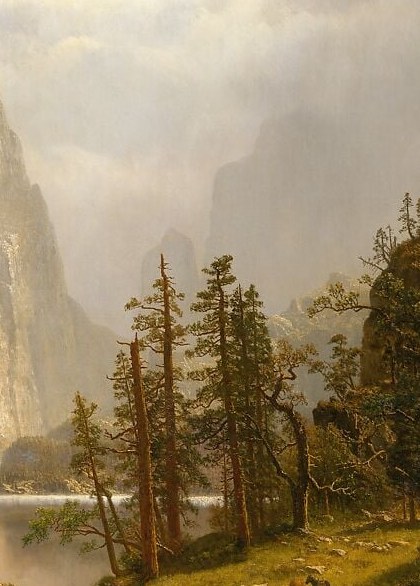
The trees serve as a vertical repoussoir element that frames the river and gives the human figures a sheltering canopy; their needle-sharp silhouettes against the misty background demonstrate Bierstadt's foreground precision.
Heavy layered clouds lit from within by diffuse light , the sky is as geologically dramatic as the rock below it, suggesting an ongoing weather event that heightens the painting's sense of sublime threat.
Transcript

Before it was a national park, it was a rumor. 1866. Most Easterners had never seen a place like this. So painters brought it back to them. Look at the scale. The cliffs, the river, the sky. And down here: people. Miwok people, who lived here for millennia. Bierstadt sold this canvas to a New York patron. Twenty-four years later, Yosemite became a national park. Paintings like this helped make that happen.