Moses Shown the Promised Land by Benjamin West
Benjamin West painted this scene of Moses on Mount Nebo in 1801, and it now hangs in The Metropolitan Museum of Art's American Wing. An American-born Quaker who became the second president of the Royal Academy in London, West was entirely self-taught, yet he rose to serve as historical painter to King George III. This painting is his meditation on a single, quiet biblical moment: the prophet, at the end of his life, glimpsing the land he would never enter.
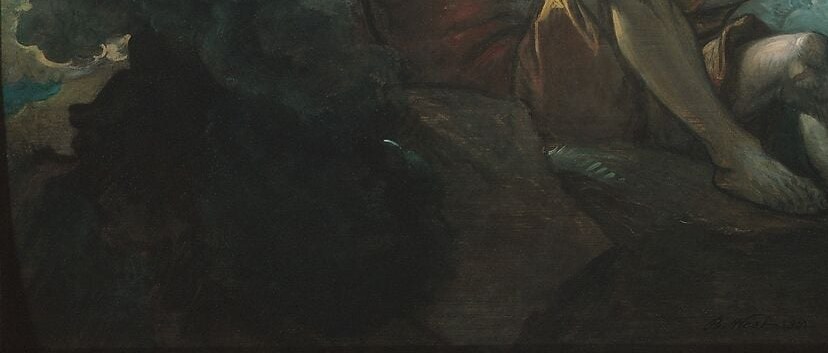
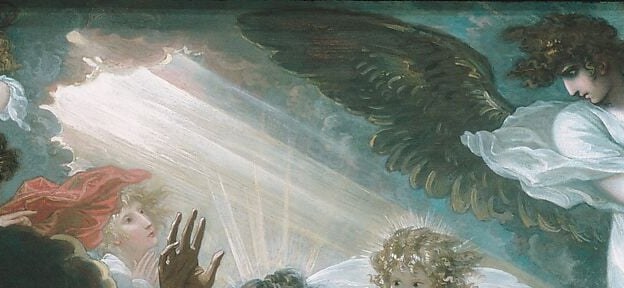
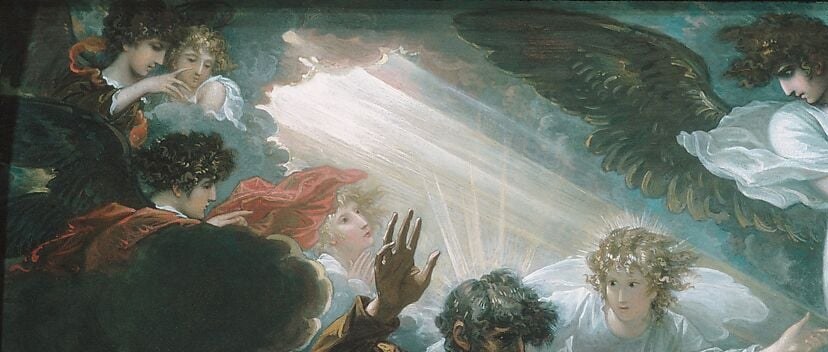
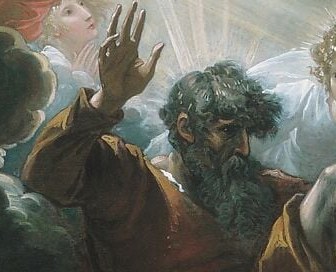
West stages the entire emotional weight of the scene through light. The foreground is a near-black slab of mountain rock, and Moses is a dark silhouette against it. From the upper center of the panel, a warm, white-gold beam cuts through rolling storm clouds and lands directly on the prophet's upturned face and on the luminous angel beside him. West makes you feel the light before you understand the geography.
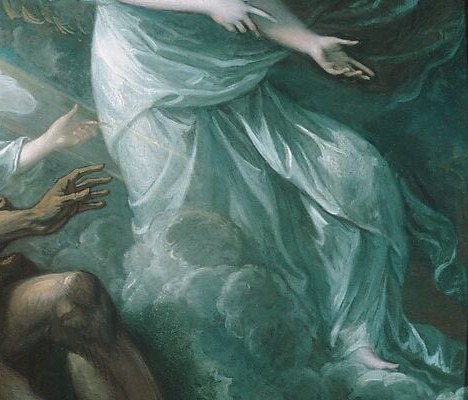
The technique is pure academic oil glazing. Over a dark brown prepared ground, West laid in the grey clouds and let them dry. Then he pulled thin, translucent amber and lead-white glazes across the cloud edges, building the glow in successive layers rather than with one opaque stroke. The angel's white drapery acts as a secondary reflector, bouncing the divine beam back into the shadowed foreground so the transition from darkness to glory feels continuous, not cut-out.
When West exhibited history paintings like this one, audiences understood them as the highest form of art, grand moral lessons in oil. Here, the lesson is entirely visual: you see a man who cannot cross the border, but who is granted the vision anyway. The land itself stays pale and soft, less a place than a promise.
Details
Transcript
Look at the darkness first. Benjamin West built this whole vision on a dark, brown ground. Then he made light EXPLODE out of the black. No white paint straight from the tube. That glow is built in layers. The angel's robe catches the light and throws it back. But the real trick is in the clouds. Warm glazes, thin as stained water, pulled over dry grey paint. And Moses's face catches the one true, unbroken beam.