Still Life Fruit and Wine Glass by Severin Roesen
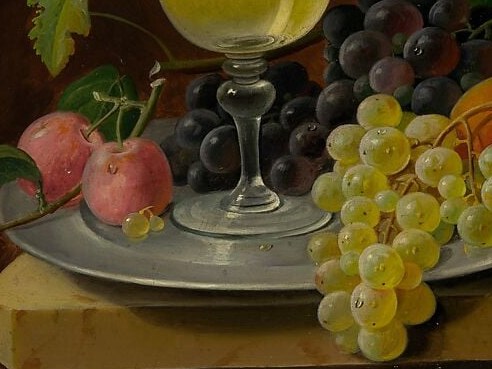
This is Severin Roesen's Still Life Fruit and Wine Glass, painted around 1865 to 1870. Roesen was a Prussian immigrant who became one of the most prolific still-life painters in nineteenth-century America, but he remains a ghost. No one knows exactly when he was born, and no one knows exactly when or where he died.
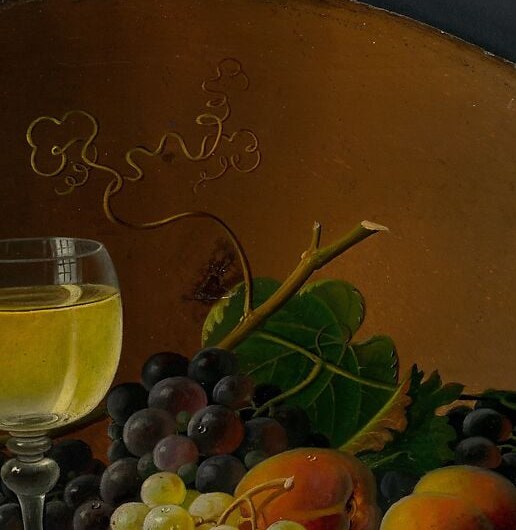
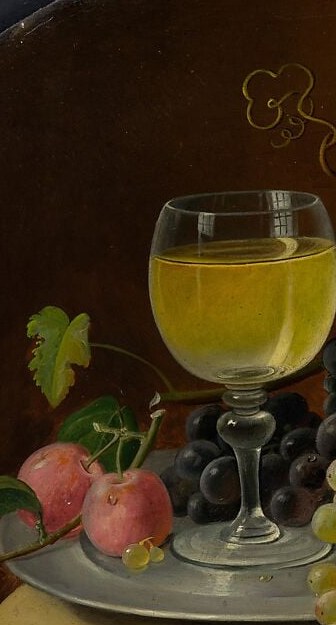
Look at the grapes. Each tiny sphere carries a single white dab of reflected light, placed with one loaded brushstroke. This is Roesen's signature shorthand, a virtuoso technique that turns a flat dark circle into a three-dimensional globe in an instant. Now look at the wine glass: the amber liquid glows, the stem nearly vanishes into transparency, and the curved bowl acts as a convex mirror, reflecting a miniature reversed still life of the fruit around it.
Roesen painted this exact arrangement, or slight variations of it, dozens and dozens of times. He was so consistent that art historians still struggle to separate his genuine works from those of his followers and imitators. He essentially cloned himself onto boards and canvas, feeding a booming American middle class that wanted abundant, optimistic pictures for their dining rooms.
Sometime around 1872, he vanished from the historical record completely. No obituary, no grave, no final letter. He left behind only the fruit, suspended in permanent ripeness, repeating the same warm invitation to look closer.
Details
Transcript
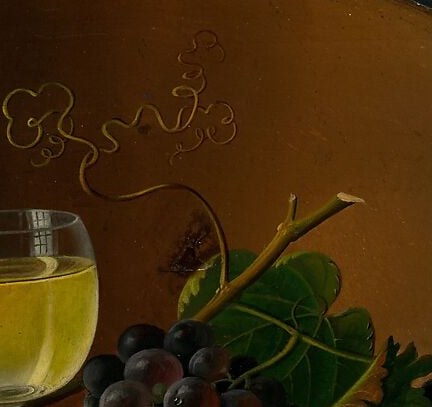
In America, a German immigrant painted this fruit. He signed it small, up here. Then he painted dozens of paintings exactly like it. Same grapes, same peach, same wine glass. He duplicated himself so well that scholars still cannot tell his hand from his imitators. And then he disappeared. No death record, no obituary. Just the fruit, repeating forever.